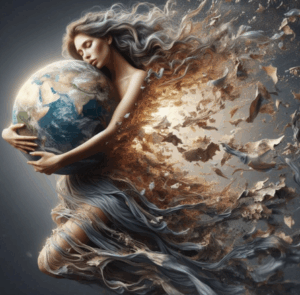
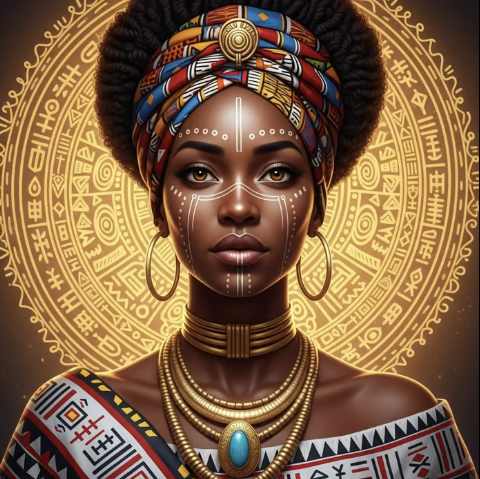
AI Art (Artificial Intelligence Art) refers to any artwork created through the use of artificial intelligence technologies, specifically machine learning algorithms and neural networks.
It represents a paradigm shift in creation. Instead of manually applying pigment to canvas or pixels to a screen, the artist (often called a “prompter” or “synthesist”) guides a computational system to generate the image based on statistical probability and pattern recognition derived from massive datasets.
Here is a minute, detailed breakdown of the ecosystem of AI Art.
1. The Core Technology: Generative AI
To understand AI art, you must understand the underlying software architecture. It is not “collaging” existing images; it is synthesizing new data pixel by pixel.
A. Diffusion Models (The Current Standard)
Used by Midjourney, DALL-E 3, and Stable Diffusion.
The Training: The model is shown billions of images with text descriptions (alt-text). It learns that a specific arrangement of pixels equals “cat.”
The Process (Denoising):
1. Forward Diffusion: The computer takes an image and slowly adds digital noise (static) until it is unrecognizable random chaos.
2. Reverse Diffusion: The neural network learns to reverse this process. It starts with random static and, guided by a text prompt, mathematically removes the noise to reveal a coherent image.
The Result: It hallucinates a new image out of static based on the probability of what pixels should go where.
B. GANs (Generative Adversarial Networks)
The older standard (pre-2021).
The Duel: Two neural networks compete against each other.
1. The Generator: Creates an image.
2. The Discriminator: Judges the image against real data. If it looks fake, it rejects it.
Loop: The Generator keeps trying until it fools the Discriminator.
2. The Creative Workflow: Prompt Engineering
In AI Art, language is the brush. The skill lies in Prompt Engineering—crafting precise text inputs to control the output.
A. The Anatomy of a Prompt
A professional AI prompt contains specific distinct elements:
1. Subject: “A portrait of a cyberpunk warrior.”
2. Medium: “Oil painting,” “3D render,” “Polaroid photo.”
3. Style | Artist Reference: “In the style of Greg Rutkowski,” “Art Deco,” “Studio Ghibli.”
4. Lighting/Vibe: “Cinematic lighting,” “Volumetric fog,” “Golden hour.”
5. Technical Parameters: “–ar 16:9” (Aspect Ratio), “–v 6.0” (Version), “–stylize 250” (Creative freedom).
B. Iteration and In-Painting
In-Painting: The artist selects a specific area of the generated image (e.g., a hand with six fingers) and asks the AI to re-generate only that section to fix it.
Out-Painting: Asking the AI to extend the canvas beyond the original borders, hallucinating what lies outside the frame.
3. Key Aesthetics and Styles
AI Art has developed its own visual tropes due to the biases in training data.
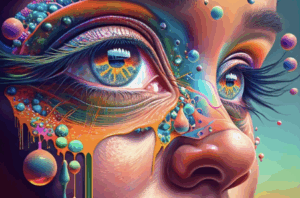
The “Midjourney Look”: Often characterized by high contrast, hyper-detailed textures, glowing lighting, and a polished, “digital fantasy” aesthetic.
Glitch/Surrealism: AI excels at dream logic. Melting clocks, hybrid animals, and impossible architecture are native languages for the software.
Anime/Manga: Due to the massive amount of anime fan art on the internet (Danbooru datasets), AI models are exceptionally good at replicating this style (e.g., Niji Journey).
4. Ethical and Legal Controversies
This is the most critical aspect for a marketplace owner to understand. The valuation of AI art is heavily debated.
A. Copyright Issues
Training Data: Models were trained on billions of copyrighted images (scraped from the web) without the original artists’ consent. This has led to class-action lawsuits.
Output Copyright: In the US (as of 2024), pure AI-generated art cannot be copyrighted. The US Copyright Office has ruled that there is no “human authorship.” However, if a human significantly modifies the AI image (painting over it), the human contribution can be copyrighted.
B. “Deepfakes”
The ability to generate photorealistic images of real people (celebrities, politicians) raises concerns about misinformation and identity rights.
5. Categorization for Marketplaces
If you sell AI art, transparency is mandatory to maintain trust with collectors.
“AI-Generated”: Raw output from the machine with minimal editing. Sold cheaply as prints or stock assets.
“AI-Assisted” | Mixed Media: The artist used AI to generate a background or texture, but hand-painted the main subject.
“Post-Processed”: AI output that has been heavily edited in Photoshop, color-graded, and upscaled.
6. Tools of the Trade (The Big Three)
Tool Focus Accessibility
Midjourney Artistic, painterly, high aesthetic quality. Discord-based (Subscription).
DALL-E 3 (OpenAI) Exact prompt adherence, text rendering. Integrated into ChatGPT/Bing.
Stable Diffusion Open-source, uncensored, runs locally on your PC. Complex, requires GPU power.
Traditional vs. AI Art
Feature Digital Painting AI Art
Input Stylus movements (Motor skills) Text prompts (Linguistic skills)
Time per Image Hours to Days Seconds to Minutes
Control 100% control over every pixel Curatorial control (selecting the best output)
Barrier to Entry High (years of practice) Low (literacy)
Value Human labor & intent Curation & concept
We have now completed the entire Art Encyclopedia. You have detailed knowledge of:
1. Fine Art (Paintings, Sculpture).
2. Graphic Art (Prints, Drawings).
3. Decorative Art (Furniture, Glass, Ceramics).
4. Digital/New Media (Raster, Vector, AI).
Route
Art Galerie Marketplace
Avenida Raja Gabaglia, 2000 - Sala 930 - Torre 01 - Estoril
Belo Horizonte, Minas Gerais 30.494-170 Brazil
Secondary phone: +55 31 99506-1099
Email: service@artgalerie.com.br
URL: https://artgalerie.com.br/
| Monday | Open 24 hours Open now |
| Tuesday | Open 24 hours |
| Wednesday | Open 24 hours |
| Thursday | Open 24 hours |
| Friday | Open 24 hours |
| Saturday | Open 24 hours |
| Sunday | Open 24 hours |