1. Historical Context: Why did it happen?
Abstract Expressionism (often called "The New York School") was born out of a specific set of historical circumstances: Post-WWII Anxiety: After the horrors of World War II and the atomic bomb, many artists felt that traditional, realistic art could no longer adequately express the human condition. They sought a visual language that could convey profound emotion, trauma, and existential angst without using literal images. The Great Depression & WPA: During the 1930s, the Works Progress Administration (WPA) hired many American artists to create murals. This experience taught them to work on a massive, architectural scale, which later became a hallmark of Abstract Expressionism. European Influence (Surrealism): As the Nazis advanced in Europe, many modern artists (like Max Ernst and Piet Mondrian) fled to New York. They brought with them the Surrealist concept of Automatism—the idea that art should come directly from the unconscious mind, bypassing rational control.2. The Two Main Styles
While the movement is grouped together, it is generally divided into two distinct technical approaches: Action Painting and Color Field Painting.A. Action Painting (Gestural Abstraction)
This style emphasizes the physical act of painting. The canvas is seen as an "arena" in which to act, rather than a space to reproduce an object. The finished painting is essentially a record of the artist's physical energy. Key Characteristics: Vigorous brushstrokes, dripping, splashing, and a sense of chaotic energy. Major Artists: Jackson Pollock: Famous for his "drip technique." He placed canvases on the floor and dripped household enamel paint from sticks and trowels, dancing around the canvas to create complex webs of line. This shattered the traditional idea of using an easel. Willem de Kooning: Known for aggressive, slashed brushstrokes. Unlike Pollock, he often kept a foot in the figurative world (e.g., his Woman series), blending violent abstraction with recognizable forms. Franz Kline: Painted stark, black-and-white compositions that resemble giant, rough calligraphy, often using house painters' brushes.B. Color Field Painting (Chromatic Abstraction)

3. Key Philosophical Concepts
To understand Abstract Expressionism, you must understand the theories that drove it: The "All-Over" Composition: Traditional Western art usually has a focal point (e.g., a person in the center). Abstract Expressionists (especially Pollock) treated every inch of the canvas as equally important. There is no center, top, or bottom. Jungian Psychology: Many of these artists were influenced by Carl Jung’s theories of the "Collective Unconscious." They believed that by painting spontaneously, they could tap into universal myths and archetypes shared by all humans. Scale: The paintings were often massive. As Mark Rothko famously said, "I paint very large pictures... precisely because I want to be intimate and human. To paint a small picture is to place yourself outside your experience... however you paint the larger picture, you are in it." Flatness: Critic Clement Greenberg, the movement's biggest champion, argued that the goal of modern art was to emphasize the "flatness" of the canvas, rejecting the illusion of 3D depth (perspective) that had dominated art since the Renaissance.4. Key Artists & Notable Works
Artist Style Notable Work Why it matters Jackson Pollock Action Autumn Rhythm (Number 30) The epitome of the drip technique; a complex web of energy without a focal point. Mark Rothko Color Field No. 61 (Rust and Blue) Demonstrates the vibrating, emotional power of simple color blocks. Willem de Kooning Action Woman I Controversial for keeping the figure (a woman) visible amidst violent abstraction. Helen Frankenthaler Color Field (Lyrical) Mountains and Sea Invented the "Soak-Stain" technique, pouring thinned paint onto raw canvas so it soaked into the fabric like dye. Lee Krasner Action The Seasons A key figure often overshadowed by her husband (Pollock), she created dense, rhythmic, and structural abstract works.5. Legacy and Decline
By the 1960s, Abstract Expressionism began to fade. A younger generation of artists felt the style had become too personal, overly emotional, and "messy." Reaction: Movements like Pop Art (Andy Warhol) and Minimalism (Donald Judd) arose as a direct reaction against Abstract Expressionism. They sought to remove the artist's "hand" and emotion from the work, favoring mechanical reproduction and hard, geometric lines. Enduring Impact: Despite its decline, Abstract Expressionism permanently changed art by proving that painting didn't need to depict a subject to be powerful. It liberated artists to use paint as a raw material for expression, a freedom that remains central to contemporary art today.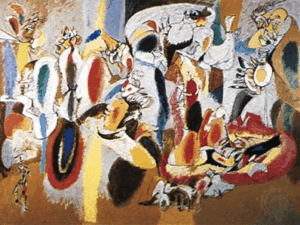
Route
Art Galerie Marketplace
5 Brayford Sq, Stepney Green
London E1 0SG United Kingdom (UK)
Additional phone number: +55 31 99506-1099
Email: service@artgalerie.com.br
URL: https://artgalerie.com.br/
| Monday | Open 24 hours |
| Tuesday | Open 24 hours |
| Wednesday | Open 24 hours Open now |
| Thursday | Open 24 hours |
| Friday | Open 24 hours |
| Saturday | Open 24 hours |
| Sunday | Open 24 hours |