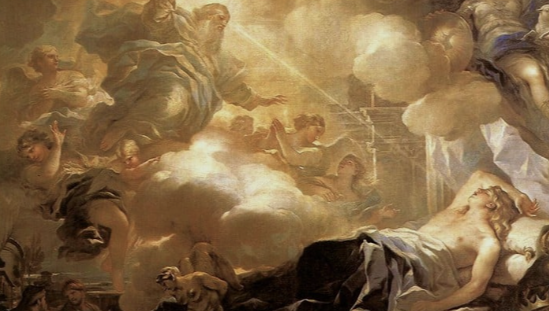
The Baroque is a period of artistic style that used exaggerated motion and clear, easily interpreted detail to produce drama, tension, exuberance, and grandeur in sculpture, painting, architecture, literature, dance, theater, and music.
Spanning roughly from 1600 to 1750, the movement began in Rome and spread across Europe. The term is derived from the Portuguese word barroco, meaning an “irregular pearl or stone”—implying that the style was strange, distorted, or irregular compared to the perfect proportions of the Renaissance.
Here is a detailed breakdown of the Baroque era.
1. The Origin: The Counter-Reformation
To understand Baroque, you must understand the politics of the Catholic Church.
The Context: In the 1500s, the Protestant Reformation (Martin Luther) shook the Catholic Church’s power. Protestants favored simple, austere churches without images.
The Response: The Catholic Church launched the Counter-Reformation. They decided that art should not be removed, but rather amplified. They wanted art that appealed to the emotions and senses of the common people, not just the intellect of the elite. They wanted to overwhelm the viewer with the glory of God.
The Result: Art became a form of spiritual propaganda—massive, theatrical, and emotionally intense.
2. Key Characteristics of Visual Arts
Baroque art is the direct opposite of the Renaissance. Where the Renaissance sought calm, balance, and reason, the Baroque sought movement, emotion, and awe.
A. Chiaroscuro and Tenebrism
Painters mastered the dramatic use of light and shadow.
Chiaroscuro: The contrast between light and dark to give figures volume.
Tenebrism: A more extreme version (pioneered by Caravaggio) where figures emerge from a pitch-black background into a spotlight. This creates a sense of psychological tension.
B. The “Moment of Action”
Renaissance art usually depicted the moment before an event (David standing still holding the sling). Baroque art depicts the moment during the action (David mid-swing, muscles straining, face grimacing).
C. Diagonal Composition
Instead of the stable triangles or pyramids of the Renaissance, Baroque artists used diagonal lines and X-shapes in their compositions to create instability and energy.

3. The Three Regional Styles
Because Europe was divided religiously and politically, Baroque manifested differently in different countries.
A. Italian & Spanish Baroque (The Religious)
Focused on the Catholic Church. It was theatrical, bloody, and miraculous.
Caravaggio (Italy): The “bad boy” of the Baroque. He painted saints as regular people with dirty feet and sunburns, using extreme Tenebrism.
Gian Lorenzo Bernini (Italy): The greatest sculptor of the era. He made marble look like soft flesh. His Ecstasy of Saint Teresa captures a saint in a moment of spiritual (and physical) rapture.
Diego Velázquez (Spain): Known for Las Meninas, a complex painting playing with mirrors and perspective, blurring the line between reality and illusion.
B. French Baroque (The Royal)
Focused on the Monarchy (King Louis XIV). It was disciplined, grand, and orderly (Classicist Baroque).
Versailles: The Palace of Versailles is the ultimate example. It was designed to show the absolute power of the “Sun King” over nature and people. It features the Hall of Mirrors and massive, geometrically controlled gardens.
C. Dutch Baroque (The Bourgeois)
The Netherlands was Protestant and a Republic (no King, no Pope). Therefore, they painted secular subjects for middle-class homes. This period is known as the Dutch Golden Age.
Rembrandt: The master of human emotion and psychological depth in portraiture.
Johannes Vermeer: Painted quiet, domestic scenes of daily life (e.g., Girl with a Pearl Earring), famous for his mastery of natural light entering through windows.
Still Life: Paintings of flowers, food, and skulls (Vanitas) intended to remind the viewer of the fleeting nature of life and wealth.
4. Baroque Architecture
Baroque buildings were designed to surprise and awe the viewer.
Curves and Ovals: Architects rejected the “perfect circle” of the Renaissance in favor of ovals and ellipses. Walls became undulating (wavy), curving in and out.
Illusionism: Ceilings were painted to look like the sky was opening up to heaven (trompe-l’œil), blurring the line between the roof and the sky.
St. Peter’s Square (Vatican): Designed by Bernini, the massive colonnades curve like two arms reaching out to embrace the faithful.
5. Baroque Music (1600–1750)
This era established the foundation of Western classical music (tonality).
Characteristics: Long, flowing melodic lines; contrast between loud and soft; and highly complex polyphony (multiple independent melody lines weaving together).
The Birth of Opera: Music began to focus on dramatic storytelling (Monteverdi).
The Giants:
Johann Sebastian Bach: The master of the Fugue (complex mathematical weaving of melodies). His death in 1750 marks the end of the Baroque period.
Antonio Vivaldi: Famous for The Four Seasons, demonstrating the Baroque love for drama and nature.
George Frideric Handel: Known for the Messiah (Hallelujah Chorus), bringing operatic drama to religious themes.

6. Summary: Renaissance vs. Baroque
A quick comparison to help you distinguish the styles:
Feature Renaissance (c. 1400–1600) Baroque (c. 1600–1750)
Goal Harmony, Balance, Reason Emotion, Drama, Awe
Composition Symmetrical, Triangular Asymmetrical, Diagonal
Lighting Even, clear lighting Dramatic contrast (Shadow/Light)
Moment Before the action (Calm) During the action (Tension)
Architecture Circles, squares, straight lines Ovals, undulating curves
Example Michelangelo’s David (Standing) Bernini’s David (Throwing)
7. The End of Baroque
By the mid-1700s, the style evolved into Rococo (which took the curves of Baroque but made them lighter, pastel, and more playful/frivolous) and eventually faced a backlash from Neoclassicism, which demanded a return to serious, straight lines and Roman logic.
Route
Art Galerie Marketplace
Avenida Raja Gabaglia, 2000 - Sala 930 - Torre 01 - Estoril
Belo Horizonte, Minas Gerais 30.494-170 Brazil
Secondary phone: +55 31 99506-1099
Email: service@artgalerie.com.br
URL: https://artgalerie.com.br/
| Monday | Open 24 hours |
| Tuesday | Open 24 hours |
| Wednesday | Open 24 hours Open now |
| Thursday | Open 24 hours |
| Friday | Open 24 hours |
| Saturday | Open 24 hours |
| Sunday | Open 24 hours |
Art Baroque