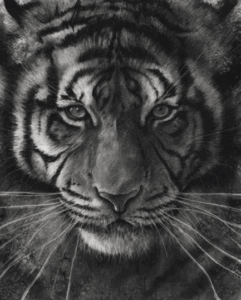
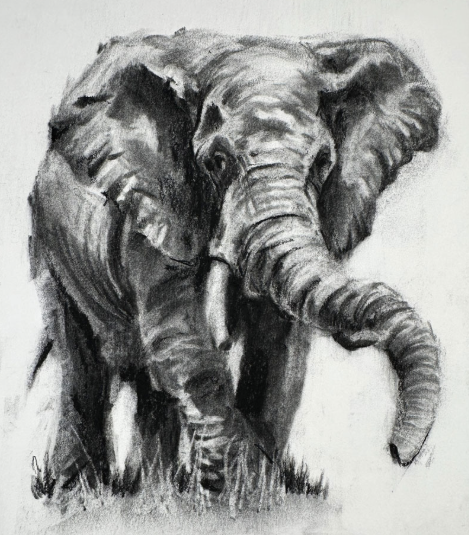
Art Charcoal is arguably the oldest art material in human history. From the charred sticks used in cave paintings 30,000 years ago to the refined tools of today, it remains the primary medium for studying value (light and shadow).
Charcoal is essentially burnt organic material (wood). Unlike graphite (pencil), which has a metallic sheen and is slippery, charcoal is matte, dry, and capable of producing the deepest, darkest blacks of any dry medium.
Here is a minute, detailed breakdown of the world of Art Charcoal.
1. The Chemistry: Carbonization
Charcoal is made by heating wood in the absence of oxygen.
The Process: If you burn wood in a fire, it turns to ash (white). If you bake wood in an airtight container (a kiln), the water and volatile gases (sap, tar) vaporize, leaving behind a skeletal structure of pure Carbon.
The Result: A lightweight, black residue that crumbles easily. The structure of the original wood cells is preserved, which gives charcoal its “scratchy” or “velvety” texture depending on the wood used.
2. The Two Main Types
Artists distinguish between “Natural” charcoal and “Manufactured” charcoal.
A. Vine and Willow (Natural Charcoal)
These are actual twigs of wood that have been carbonized. They contain no binders.
Vine Charcoal: Made from grape vines (Vitis vinifera). It is usually thin, straight, and makes a dark grey mark. It is very soft and powdery.
Willow Charcoal: Made from willow branches (Salix). It is often thicker and slightly darker/blacker than vine.
Characteristics:
Erasability: It can be wiped off the paper with a mere brush of the hand or a cloth. It is ephemeral.
Usage: Used for the initial layout or “under-drawing” of a painting because it doesn’t stain the canvas and is easily corrected.
B. Compressed Charcoal (Manufactured)
This is charcoal powder mixed with a gum or wax binder and compressed into sticks or pencils.
Hardness Scale: The amount of binder determines the hardness. More binder = Harder/Lighter; Less binder = Softer/Darker (e.g., HB, 2B, 4B, 6B).
Characteristics:
Darkness: It produces an intense, pitch-black mark that absorbs almost all light.
Permanence: Because of the binder, it adheres strongly to the paper. It is very difficult to erase completely. Once you make a mark with compressed charcoal, you are committed.
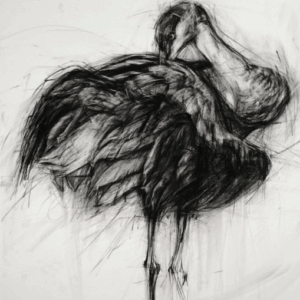
3. Form Factors
Charcoal comes in various shapes to facilitate different techniques.
Sticks/Batons: Raw sticks of vine or compressed charcoal. Artists often snap them in half and use the side of the stick to block in large areas of shadow instantly.
Pencils: Compressed charcoal encased in wood or paper. Used for fine details (eyes, wrinkles). They are much more brittle than graphite pencils and must be sharpened with a razor blade, not a pencil sharpener (which will crush the core).
Powder: Jars of loose charcoal dust. Artists dip a brush or a cloth into the powder to cover massive backgrounds or create soft, atmospheric clouds.
4. The Essential Tool: The Eraser
In charcoal drawing, the eraser is not for correcting mistakes; it is a drawing tool.
Kneaded Eraser (Putty Rubber): A soft, pliable gum that absorbs charcoal dust rather than rubbing it away. It can be shaped into a fine point to “lift out” highlights (like the reflection in an eye) from a dark mass of charcoal.
Subtractive Drawing: A common technique is to cover the entire paper in charcoal (toning the ground) and then use the eraser to “draw the light,” removing the black to reveal the white paper.
5. Blending Tools
Charcoal is messy. Oils from human fingers can stain the paper, causing the charcoal to stick unevenly. Therefore, artists use tools to blend:
Stump (Tortillon): A tightly rolled cylinder of paper pointed at both ends. It pushes the charcoal into the tooth of the paper, creating smooth transitions.
Chamois: A piece of soft leather used to wipe charcoal off or soften textures.
Brushes: Stiff bristle brushes can push charcoal powder around for a painterly effect.
6. The Surface: Tooth
Charcoal requires textured paper.
Tooth: The microscopic pits and valleys on the surface of the paper.
The Mechanism: Charcoal sits on top of the paper; it doesn’t sink in like ink. The “tooth” acts like a grater, shaving the charcoal off the stick and holding it in the valleys.
Smooth Paper: If the paper is too smooth (like printer paper), the charcoal will slide right off.
Rough Paper: If the paper is too rough, it will eat the charcoal stick rapidly and prevent fine detail.
7. “White Charcoal”
You will often see “White Charcoal” sold in sets.
The Secret: It is not charcoal (you cannot burn wood to turn it white). It is usually Titanium White pigment or Calcium Carbonate mixed with a clay binder.
Usage: Used on toned paper (grey or tan) to draw the extreme highlights, while black charcoal draws the shadows.
8. Preservation: The Fixative
Because charcoal is just dust sitting on paper, a sneeze or a smudge can ruin a drawing.
Workable Fixative: A spray that glues the charcoal down but creates a toothy surface so you can continue drawing over it.
Final Fixative: A stronger spray used when the art is finished.
The Warning: Fixative often darkens the art. It wets the particles, causing the lighter greys to vanish into the blacks.
Summary Comparison: Graphite vs. Charcoal
Feature Graphite (Pencil) Charcoal
Material Carbon + Clay (Mineral) Carbonized Wood (Organic)
Finish Shiny / Metallic Matte / Velvet
Blackness Dark Grey (at best) Pitch Black
Speed Slow, linear Fast, expressive
Detail Micro-precision Broad, atmospheric
Mess Minimal, High (dust everywhere)
Strategic Pivot:
We have now covered the Graphic Arts ecosystem (Sketching, Charcoal, Graphic Design).
Route
Art Galerie Marketplace
Avenida Raja Gabaglia, 2000 - Sala 930 - Torre 01 - Estoril
Belo Horizonte, Minas Gerais 30.494-170 Brazil
Secondary phone: +55 31 99506-1099
Email: service@artgalerie.com.br
URL: https://artgalerie.com.br/
| Monday | Open 24 hours Open now |
| Tuesday | Open 24 hours |
| Wednesday | Open 24 hours |
| Thursday | Open 24 hours |
| Friday | Open 24 hours |
| Saturday | Open 24 hours |
| Sunday | Open 24 hours |