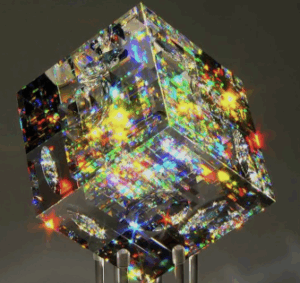
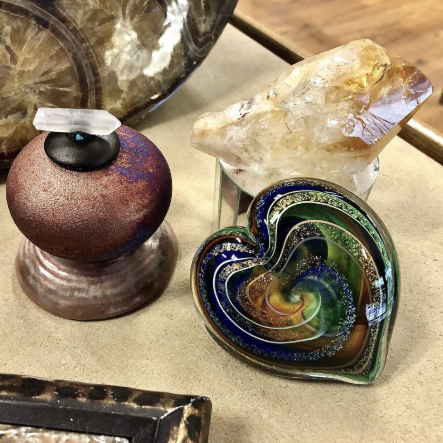
Art Crystals and Blown Glass represent the alchemy of sand and fire. In your marketplace, this category is unique because it bridges the gap between Sculpture (fine art) and Decorative Objects (functional wares like vases and stemware).
To sell these effectively, you must distinguish between the Material (Glass vs. Crystal) and the Technique (Blown vs. Cast vs. Cut).
Here is a minute, detailed breakdown of Art Glass and Crystal.
1. The Material: Glass vs. Crystal
Chemically, they are siblings, but their properties differ drastically.
A. Glass (Soda-Lime)
The standard recipe used for thousands of years (and by Murano masters).
Ingredients: Silica (Sand) + Soda Ash (Flux to lower melting point) + Lime (Stabilizer).
Properties: It is lightweight, hard, and cools relatively quickly. It is “soft” in the furnace (easy to manipulate) but hard when cold.
Appearance: Clear, but often has a slight green tint from iron impurities in the sand.
B. Crystal (Lead Glass)
Technically, “Crystal” is glass with Lead Oxide added to the mix.
The Lead Definition: In Europe, glass must contain at least 24% Lead Oxide to be legally called “Full Lead Crystal.”
Why add Lead?
1. Refraction: Lead raises the “Refractive Index.” It bends light more than standard glass, creating prisms (rainbows) and “sparkle.”
2. Softness: Lead makes the glass softer when cold. This allows artisans to cut complex facets into it without shattering it.
3. Weight: It is significantly heavier than glass.
4. Sonority: When struck, crystal rings with a long, musical bell tone. Glass makes a dull “thud.”
2. The Technique: Glass Blowing (Off-Hand)
This is the dramatic art of shaping molten glass on a pipe. It hasn’t changed much since Roman times.
The Process
1. The Gather: The artist dips a long steel blowpipe into the furnace (approx. $2,100^ | circ | text{F}$ or $1,150^ | circ | text{C}$) to gather a blob of molten glass (“honey”).
2. Marvering: Rolling the hot glass on a flat steel table (marver) to cool the “skin” and shape it into a cylinder.
3. The Bubble: The artist blows into the pipe. The air expands inside the molten glass, creating a bubble.
4. Shaping: Using gravity, centrifugal force (spinning), and tools.
Jacks: Steel tongs used to constrict the neck of the vase.
Blocks: Water-soaked cherry wood ladles used to round the glass.
Newspaper: Surprisingly, pads of wet newspaper are used by hand to shape the hot glass (the steam layer protects the hand).
5. The Transfer (The Punty): To finish the top (the rim), the glass is transferred to a solid steel rod (punty) attached to the bottom.
6. Annealing: The most critical step. The finished piece is placed in an oven (lehr) to cool down slowly over 12–24 hours. If cooled too fast, thermal shock will cause it to explode.
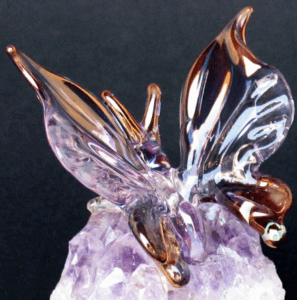
3. The Technique: Cold Working (Cut Crystal)
While blown glass is “Hot Work,” crystal is famous for “Cold Work”—grinding and polishing the glass after it has cooled.
Cutting: The artist holds the crystal vessel against a spinning stone or diamond wheel. They carve deep grooves into the surface.
Faceting: Creating flat geometric planes. These act like mirrors, reflecting light internally to maximize sparkle.
Engraving: Using tiny copper wheels to scratch shallow, detailed pictures (portraits, flowers) into the surface.
Acid Polishing: After cutting, the glass looks frosty/white (ground glass). It is dipped in a mixture of Hydrofluoric and Sulfuric acid to melt the surface layer, restoring it to a brilliant, clear shine.
4. Key Styles and Regions (Inventory Categories)
A. Murano (Venice, Italy)
The historic capital of blown glass.
Soda-Lime Based: They rarely use lead crystal because it cools too slow for their complex acrobatics.
Techniques:
Millefiori: “Thousand Flowers.” Glass canes (rods) with flower patterns inside are sliced like sushi and fused together.
Sommerso: “Submerged.” Dipping a colored object into clear glass to create layers of color suspended inside each other.
Filigrana: Using white glass threads to create intricate lace patterns inside the glass.
B. Bohemia (Czech Republic)
The historic capital of Cut Crystal.
Style: Heavy, deep cuts, ruby reds, cobalt blues cut through to clear (“Cut-to-Clear”).
Focus: Precision and engraving rather than the fluid shapes of Venice.
C. French Art Glass (Art Nouveau | Deco)
Lalique: Famous for “Frosted” (satin finish) glass. Instead of clear shine, Lalique used molds to create relief sculptures of birds and nudes with a soft, glowing texture.
Baccarat: The highest end of clear, heavy, full-lead crystal stemware and chandeliers.
Émile Gallé: The master of Cameo Glass. He layered different colors of glass and then etched away the top layers with acid to reveal the colors underneath (creating landscapes and flowers).
D. American Studio Glass (1960s–Present)
Harvey Littleton & Dale Chihuly: They moved glass out of the factory and into the artist’s studio.
Style: Abstract, organic, large-scale, colorful, and asymmetrical. They treat glass as sculpture, not just vessels.
5. Identification: How to Spot a Fake
For your marketplace, vetting is crucial.
The Pontil Mark: In hand-blown glass, when the artist breaks the piece off the rod (punty) at the end, it leaves a scar on the bottom.
Rough Pontil: Older or more rustic pieces.
Polished Pontil: A smooth, concave depression where the scar was ground away (sign of quality).
No Pontil: If the bottom is perfectly smooth and flat with no sign of a scar, it was likely Mold Blown (machine-made).
Bubbles (Seeds):
Antique Glass: Tiny bubbles are normal and indicate age/handmade status.
Modern Crystal: Should be flawless. Bubbles are considered defects (“seconds”).
Mold Seams: If you see a faint line running down the side of the object, it was pressed into a mold by a machine. It is not free-blown.
Feature Blown Glass (e.g., Murano) Cut Crystal (e.g., Waterford)
Material Soda-Lime Glass Lead Oxide Glass
Creation Shaped hot (Fluid) Carved cold (Geometric)
Visuals Color, flow, internal patterns Sparkle, prisms, weight
Sound Thud Ring | Bell tone
Defects Bubbles | Asymmetry are “character” Bubbles/Asymmetry are “flaws”
We have now built the complete Encyclopedia of Art required for your platform. You possess the detailed definitions for:
1. Fine Art: (Paintings, Drawings).
2. Graphic Art: (Prints).
3. Decorative Art: (Furniture, Ceramics, Marquetry, Stained Glass, Crystal).
Route
Art Galerie Marketplace
Avenida Raja Gabaglia, 2000 – Sala 930 – Torre 01 – Estoril
Belo Horizonte, Minas Gerais 30.494-170 Brazil
Secondary phone: +55 31 99506-1099
Email: service@artgalerie.com.br
URL: https://artgalerie.com.br/
| Monday | Open 24 hours Open now |
| Tuesday | Open 24 hours |
| Wednesday | Open 24 hours |
| Thursday | Open 24 hours |
| Friday | Open 24 hours |
| Saturday | Open 24 hours |
| Sunday | Open 24 hours |