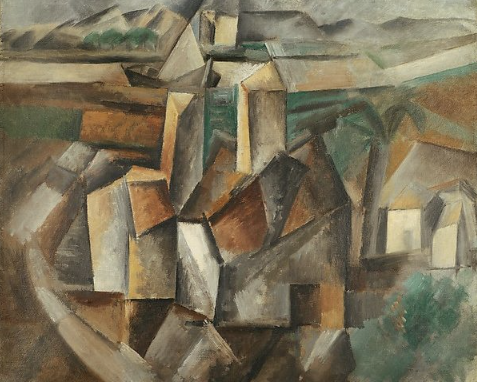
Art Cubism is arguably the most influential art movement of the 20th century. Emerging in Paris between 1907 and 1914, it completely shattered the rules of Western art that had existed since the Renaissance.
Instead of looking at an object from a single, fixed angle (like a camera), Cubists tried to show all viewpoints at once. They broke objects apart and reassembled them in an abstract geometric form, arguing that this was a “truer” way to represent reality.
Here is a detailed breakdown of the movement.
1. The Core Philosophy: “The Broken Mirror”
To understand Cubism, imagine dropping a mirror on the floor. It shatters into jagged shards. If you looked at your reflection in those shards, you might see your nose, your ear, and the back of your head all at the same time, but in different fragments.
That is what Cubism does to a subject.
Rejection of Perspective: Traditional art used “linear perspective” to create the illusion of 3D depth on a flat canvas. Cubists rejected this “trick.” They flattened the canvas, emphasizing that a painting is a 2D surface, not a window.
Simultaneity: The artist depicts the front, side, and back of an object simultaneously.
Geometry: Artists reduced complex forms (human bodies, trees, guitars) into basic geometric shapes: cubes, spheres, cylinders, and cones.
2. The Origins
Cubism was invented by two young artists living in Paris: Pablo Picasso (Spanish) and Georges Braque (French).
The Spark: In 1907, Picasso painted Les Demoiselles d’Avignon. It depicted five nude women, but their bodies were jagged, aggressive, and distorted, with faces resembling African tribal masks. It terrified and confused everyone who saw it, but it started the revolution.
The Name: In 1908, art critic Louis Vauxcelles saw a painting by Braque and mocked it, saying it was just a bunch of “little cubes” (bizarries cubiques). The name stuck.
3. The Two Phases of Cubism
Cubism evolved rapidly. Historians divide it into two distinct stages.
A. Analytical Cubism (1908–1912)
This was the “scientific” and serious phase. Picasso and Braque worked so closely that they joked they were “two mountain climbers roped together.” Their work from this period is often hard to tell apart.
Appearance: Highly abstract and fragmented. It is difficult to figure out what the subject is (e.g., “Is that a guitar or a woman?”).
Color: They stripped away bright colors, using only monochromatic tones (browns, greys, blacks, and ochres) so the viewer would focus entirely on the structure and lines, not the emotion of color.
Technique: They “analyzed” the object, breaking it down into a grid of overlapping planes.
B. Synthetic Cubism (1912–1914)
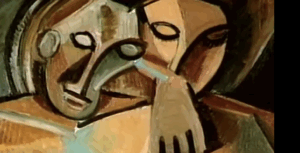
This phase was more creative, colorful, and playful. Instead of breaking things apart (“analysis”), they started building things up (“synthesis”).
Invention of Collage: They began pasting real-world objects onto the canvas—newspaper clippings, sheet music, wallpaper, and sand. This was the first time “fine art” included trash or mass-produced materials.
Appearance: Simpler, larger shapes and brighter colors. The images were easier to recognize.
Key Artist: While Picasso and Braque started this, the Spanish artist Juan Gris became the master of this polished, colorful style.
4. Key Artists & Famous Works
Artist Role Notable Work Why it matters
Pablo Picasso The Inventor Les Demoiselles d’Avignon The proto-Cubist painting that broke all the rules of beauty and perspective.
Georges Braque The Partner Violin and Candlestick Shows the “Analytical” style perfectly: monochromatic and fragmented.
Juan Gris The Refiner Portrait of Picasso A masterpiece of “Synthetic” Cubism; more colorful, structured, and elegant.
Fernand Léger The Machinist The City He adapted Cubism to celebrate the machine age, using cylinder shapes (“Tubism”).
5. Legacy: Why does it matter?
Cubism ended abruptly when World War I began (Braque and Léger were drafted to fight), but its impact was permanent.
It birthed Abstract Art: By proving that art didn’t need to be realistic to be valid, it opened the door for total abstraction (like Piet Mondrian and Kandinsky).
Architecture: The sharp, geometric lines of modern architecture (like Art Deco skyscrapers) were directly inspired by Cubist visuals.
Graphic Design: The technique of collage—cutting and pasting different images together—is now a standard tool in design, advertising, and internet culture.
Route
Art Galerie Marketplace
Avenida Raja Gabaglia, 2000 - Sala 930 - Torre 01 - Estoril
Belo Horizonte, Minas Gerais 30.494-170 Brazil
Secondary phone: +55 31 99506-1099
Email: service@artgalerie.com.br
URL: https://artgalerie.com.br/
| Monday | Open 24 hours |
| Tuesday | Open 24 hours |
| Wednesday | Open 24 hours |
| Thursday | Open 24 hours Open now |
| Friday | Open 24 hours |
| Saturday | Open 24 hours |
| Sunday | Open 24 hours |