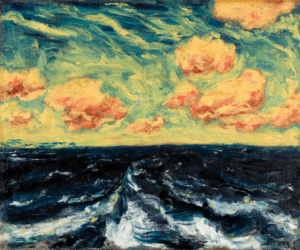
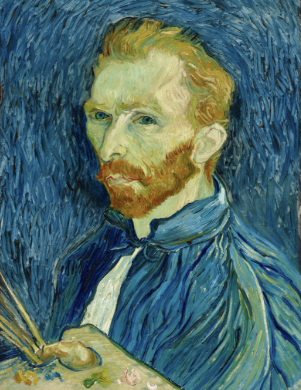
Art Expressionism was a modernist movement, initially in poetry and painting, originating in Germany at the beginning of the 20th century (roughly 1905–1933). Its typical trait is to present the world solely from a subjective perspective, radically distorting it for emotional effect in order to evoke moods or ideas.
If Impressionism was about painting what the eye sees (light and nature), Expressionism was about painting what the mind feels (anxiety, fear, love, and anger). It is the art of inner psychological reality.
Here is a detailed breakdown of the movement.
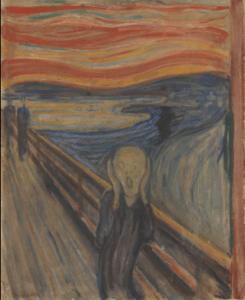
1. The Core Philosophy: “The Scream”
Expressionism emerged during a time of great change in Europe. Industrialization was destroying nature, cities were becoming crowded and alienating, and World War I was looming.
Rejection of Realism: Expressionists did not care about making a person look “realistic.” If the person felt sick or terrified, the artist might paint their face green or their body twisted.
Emotional Intensity: The goal was to shock the viewer or make them feel the artist’s angst.
The Precursor: The movement is heavily indebted to the Norwegian artist Edvard Munch. His famous painting The Scream (1893) is the spiritual grandfather of Expressionism—a landscape warped by the sheer force of human panic.
2. The Two Main German Groups
While Expressionism was a broad trend, it was defined by two specific groups of artists in Germany.
A. Die Brücke (The Bridge) — Dresden/Berlin (1905)
Founded by Ernst Ludwig Kirchner, this group wanted to be a “bridge” to a new future.
Style: Raw, aggressive, and jagged. They were influenced by “primitive” art (African and Oceanic masks).
Themes: They painted the dark side of modern city life—prostitutes, alienation, and the artificiality of urban society. Their figures often look sharp, spiked, and uncomfortable.
Key Artists: Ernst Ludwig Kirchner, Emil Nolde, Karl Schmidt-Rottluff.
B. Der Blaue Reiter (The Blue Rider) — Munich (1911)
Founded by Wassily Kandinsky and Franz Marc. This group was more intellectual, spiritual, and mystical than Die Brücke.
Style: They moved away from painting objects entirely and moved toward Abstraction. They believed colors had spiritual values (e.g., Blue is the male principle/spiritual; Yellow is the female principle/joyful).
Themes: Nature, animals, and spirituality.
Key Artists: Wassily Kandinsky, Franz Marc, Paul Klee.
3. Austrian Expressionism (The Psychological)
While the Germans focused on colors and groups, the Austrians (specifically in Vienna) focused on the distorted human body and sexuality.
Egon Schiele: His work is instantly recognizable for its twisted, emaciated bodies and raw sexuality. His lines are nervous and jagged.
Oskar Kokoschka: Known for his “psychological portraits,” where he tried to paint the soul of the sitter rather than their face, often resulting in swirling, chaotic brushstrokes.
4. Key Characteristics
How do you identify an Expressionist painting? Look for:
Swirling or Jagged Brushstrokes: The paint is applied thickly and aggressively.
Arbitrary Color: The sky might be red, the grass blue, and a face yellow. Colors are chosen for how they feel, not how they look.
Distorted Forms: Elongated limbs, grotesque faces, and exaggerated perspectives.
5. German Expressionist Cinema
Expressionism didn’t stay on the canvas. After World War I, it exploded into German cinema, creating some of the most visually striking movies ever made.
Style: Directors used painted sets with impossible angles, high-contrast lighting (heavy shadows), and exaggerated acting to portray madness and horror.
The Cabinet of Dr. Caligari (1920): The ultimate example. The sets are painted with crooked windows and tilted walls to reflect the insanity of the narrator.
Nosferatu (1922): The first Dracula movie. Count Orlok is a rat-like, stiff, Expressionist monster, and the use of shadows created the template for the Horror genre.
6. Key Artists & Notable Works
Artist Group/Region Notable Work Why it matters
Edvard Munch Norway (Precursor) The Scream The universal symbol of anxiety; nature screaming in pain.
Ernst Ludwig Kirchner Die Brücke Street, Berlin Captures the rush, danger, and artificiality of city life with sharp, jagged figures.
Franz Marc Blue Rider Large Blue Horses Uses animals and symbolic colors to show a spiritual harmony with nature.
Wassily Kandinsky Blue Rider Composition VII One of the first purely abstract paintings in history; visual music.
Egon Schiele Austria Self-Portrait with Physalis Brutally honest, twisted self-portraiture.
Käthe Kollwitz Independent The Survivors Used Expressionism to depict the tragedy of war, poverty, and grief (mostly in charcoal/prints).
7. The End: “Degenerate Art”
Expressionism came to a tragic end with the rise of Adolf Hitler and the Nazi Party in 1933.
The Ban: Hitler (a failed realistic painter) hated modern art. He called Expressionism “elitist” and “sick.”
Degenerate Art Exhibition (1937): The Nazis confiscated thousands of Expressionist works and put them in a show called Entartete Kunst (Degenerate Art). They hung the paintings crookedly, wrote mocking graffiti on the walls, and hired actors to insult the art, encouraging the public to laugh at it.
The Result: Many Expressionist artists fled Germany (mostly to the US), committed suicide (Kirchner), or were forbidden from painting (Nolde).
Route
Art Galerie Marketplace
Avenida Raja Gabaglia, 2000 - Sala 930 - Torre 01 - Estoril
Belo Horizonte, Minas Gerais 30.494-170 Brazil
Secondary phone: +55 31 99506-1099
Email: service@artgalerie.com.br
URL: https://artgalerie.com.br/
| Monday | Open 24 hours |
| Tuesday | Open 24 hours |
| Wednesday | Open 24 hours Open now |
| Thursday | Open 24 hours |
| Friday | Open 24 hours |
| Saturday | Open 24 hours |
| Sunday | Open 24 hours |