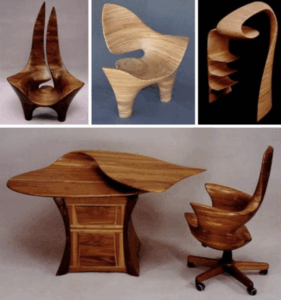
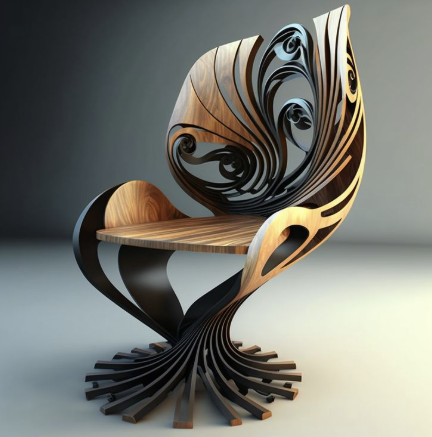
Art Furniture Making (often referred to as Studio Furniture) is a sub-discipline of the decorative arts where furniture is created not merely as a functional object, but as a unique, expressive work of art.
Unlike mass-produced factory furniture, Art Furniture is typically one-of-a-kind (bespoke) or produced in very limited editions by a single artisan or a small workshop. It blurs the line between sculpture and utility.
Here is a minute, detailed breakdown of the world of Art Furniture Making.
1. The Core Philosophy: “Function as a Canvas”
In traditional carpentry, the goal is utility. In Art Furniture, utility is the constraint, not the only goal.
The Tension: The artist must balance Ergonomics (Can you sit on it?) with Expression (Does it convey an emotion or concept?).
The “Slow” Movement: It rejects the speed of industrial manufacturing. A single chair might take 200 hours to craft. The value lies in the visible evidence of the human hand (tool marks, joinery, finish).
2. The Materials: Beyond Standard Lumber
Art furniture makers are obsessed with the character of the material. They don’t just order wood; they hunt for it.
A. Wood Selection (The Soul of the Piece)
Figured Wood: Wood with abnormal grain patterns caused by stress or injury to the tree.
Burl: Knotted, swirling grain from a tree growth.
Chatoyancy: The “cat’s eye” effect where the wood seems to shimmer and change depth when moved in the light (e.g., Tiger Maple).
Spalting: Black lines and color changes caused by fungus decaying the wood.
Live Edge: Keeping the natural bark edge of the tree slab rather than cutting it straight (popularized by George Nakashima).
B. Mixed Media
Contemporary art furniture often incorporates non-wood elements:
Resin/Epoxy: Used to fill voids or create “river tables.”
Metal: Bronze or steel legs, often cast or forged by hand.
Concrete: Polished architectural concrete for surfaces.
3. Joinery: The “Secret Handshake”
How pieces of wood are connected is the primary indicator of quality. In Art Furniture, joinery is often exposed and exaggerated to show off skill.
Dovetails: Interlocking trapezoidal fingers. The hallmark of a handmade drawer.
Blind Dovetail: Invisible from the outside (clean look).
Through Dovetail: Visible end grain (structural look).
Mortise and Tenon: A projecting tongue (tenon) fits into a rectangular hole (mortise). The strongest joint in woodworking.
Tusk Tenon: A visible tenon secured by a wedge (tusk) on the outside, allowing the furniture to be disassembled (“knock-down”).
Butterfly Key (Dutchman): An hourglass-shaped piece of wood inlaid across a crack in a slab to prevent it from splitting further. It is functional decoration.
4. Techniques of Fabrication
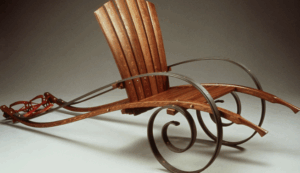
A. Bending Wood
Steam Bending: Wood is heated in a steam box until the lignin (natural glue) softens. It is then clamped around a form. When it cools, it holds the curve (e.g., Thonet chairs).
Bent Lamination: Thin strips of wood (veneers) are glued together over a curved mold. This creates incredibly strong, rigid curves.
B. Carving and Shaping
Relief Carving: Removing background wood to make a design stand out.
Shaping (Maloof Joint): Invented by Sam Maloof. The leg of a chair blends seamlessly into the seat with no hard angles. It requires sculpting with rasps and files, not just cutting with saws.
C. Veneering and Marquetry
Veneering: Gluing a thin slice of expensive, rare wood over a stable core (like MDF or secondary wood). This allows for complex grain matching (book-matching) that isn’t possible with solid wood.
Marquetry: “Painting with wood.” cutting tiny pieces of veneer to form a picture or pattern.
5. The Finishing Process
The finish protects the wood and enhances the grain. In Art Furniture, this is a multi-week process.
French Polish: The most labor-intensive finish. Hundreds of thin layers of Shellac (dissolved beetle secretion) are applied with a cloth pad (“rubber”) to create a mirror-like, high-gloss depth.
Oil Finish: Tung oil or Linseed oil penetrates the wood. It leaves a matte, natural feel. It doesn’t build a film, so you feel the wood, not plastic.
Ebonizing: Using a chemical reaction (iron acetate) to turn wood black, mimicking ebony, rather than painting it.
6. Key Historical Movements & Figures
A. Arts & Crafts (1880–1920)
Gustav Stickley: Honest, sturdy, oak furniture with visible joinery. “Truth to materials.”
B. Art Nouveau (1890–1910)
Louis Majorelle: Furniture that looks like growing vines. Complex curves that required immense skill to carve.
C. Art Deco (1920–1940)
Émile-Jacques Ruhlmann: The “high style.” Using ivory, sharkskin, and macassar ebony. Furniture for the elite.
D. The American Studio Furniture Movement (1950s–Present)
This is the modern definition of “Art Furniture.”
Wharton Esherick: The “Dean” of the movement. He treated furniture like sculpture, often using organic, asymmetrical shapes.
George Nakashima: The father of the “Live Edge” table. He believed in giving the tree a “second life.”
Sam Maloof: Famous for his rocking chairs. He perfected the organic, sculpted joint.
Wendell Castle: Known for “stack lamination”—gluing thick blocks of wood together and carving them into biomorphic, blob-like shapes.
7. The Market: How to Value It
In your marketplace, Art Furniture is valued differently than antique furniture.
1. The Maker: Is the artist known? (Studio Furniture has its own “celebrities”).
2. The Wood: Is the material rare? (e.g., a single slab of Walnut that is 10 feet long is worth thousands before it is even touched).
3. The Complexity: Does it have drawers? (Drawers are the hardest thing to make perfectly). Are there complex curves?
4. Unique vs. Edition: Is it a “one-off” or part of a “limited run” of 50?
Summary Table: Commercial vs. Art Furniture
Feature Commercial Furniture Art (Studio) Furniture
Production Mass-produced (Factory) Handmade (One-off)
Material Particle board, Plywood, thin Veneer Solid hardwood, rare slabs
Joinery Dowels, screws, staples Dovetails, Mortise & Tenon
Finish Sprayed Lacquer (PU) Hand-rubbed Oil or Shellac
Goal Consistency & Cost Uniqueness & Expression
Strategic Conclusion:
This completes the deep dive into the physical objects of the art world. You now have the knowledge to categorize:
Fine Art: (Paintings, Drawings)
Graphic Art: (Prints, Posters)
Decorative Art | Design: (Ceramics, Furniture, Textiles)
Route
Art Galerie Marketplace
Avenida Raja Gabaglia, 2000 - Sala 930 - Torre 01 - Estoril
Belo Horizonte, Minas Gerais 30.494-170 Brazil
Secondary phone: +55 31 99506-1099
Email: service@artgalerie.com.br
URL: https://artgalerie.com.br/
| Monday | Open 24 hours |
| Tuesday | Open 24 hours |
| Wednesday | Open 24 hours Open now |
| Thursday | Open 24 hours |
| Friday | Open 24 hours |
| Saturday | Open 24 hours |
| Sunday | Open 24 hours |