Art Impressionism is perhaps the most famous and beloved art movement in history, but when it began in Paris in the 1860s and 1870s, it was despised. It was a radical rebellion against the established art world.
Impressionism is not about painting an object (like a tree or a person) exactly as it is structurally. It is about painting the light that reflects off that object at a specific moment in time. It is the art of “immediate perception.”
Here is a detailed breakdown of the movement.
1. The Context: The Rebellion Against “The Academy”
To understand Impressionism, you have to understand what they were fighting against.
The Académie des Beaux-Arts: This was the “police” of French art. They held an annual exhibition called The Salon.
The Rules: The Salon only accepted paintings with invisible brushstrokes, dark colors, and “noble” subjects (history, mythology, or religion).
The Rebels: A group of young painters (Monet, Renoir, Bazille, Sisley) were rejected by the Salon again and again. They decided to bypass the system and hold their own exhibition in 1874.
2. The Name: “Just an Impression”
The name “Impressionism” was originally a sarcastic insult.
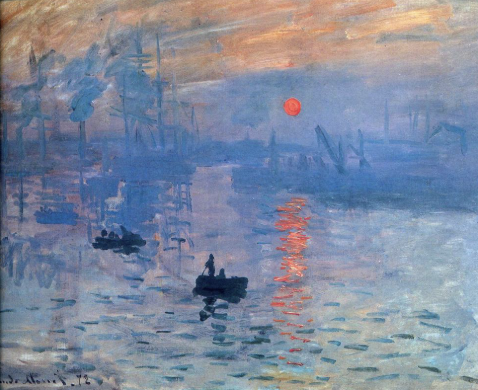
The Painting: Claude Monet exhibited a painting of the harbor in Le Havre called Impression, Sunrise . It was loose, hazy, and orange.
The Critic: A critic named Louis Leroy wrote a scathing review. He mocked the title, stating that wallpaper was more “finished” than this painting. He called the group “Impressionists”—implying they couldn’t actually paint, they could only give a vague impression.
The Reaction: The artists loved the name and adopted it as their badge of honor.
3. Key Characteristics & Techniques
Impressionism changed how paint was applied to canvas.
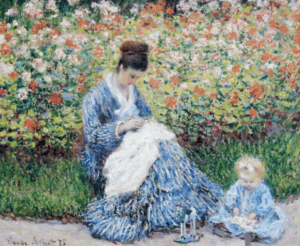
A. “En Plein Air” (In the Open Air)
Before this, landscapes were sketched outside but painted inside a studio. Impressionists took their easels outside and painted the whole thing on the spot.
Tech Enabler: This was only possible because of the invention of paint in metal tubes (1841). Before this, artists had to mix powders in the studio. Tubes allowed paint to be portable.
B. The Brushstroke (The “Tache”)
They used short, thick strokes of paint (commas, dashes, or blobs) called taches.
Why? They were trying to capture movement and fleeting light. A smooth, blended finish takes too long; if you are painting a sunset, you only have 15 minutes before the light changes.
C. Broken Color & No Black
Impressionists realized that shadows are almost never truly black. They are violet, blue, or dark green.
Optical Mixing: Instead of mixing green on a palette, they might dab yellow and blue next to each other on the canvas. From a distance, the viewer’s eye mixes them into a vibrating green.
D. Subject Matter: Modern Life
They stopped painting Greek gods and battles. They painted the middle class:
Picnics in the park.
Boating on the river.
Train stations (steam and smoke).
Cabarets and dancers.
4. The Key Artists (The Core Group)
Each artist had a specific focus within the style.
Artist Focus Notable Traits
Claude Monet Light & Nature The leader. He famously painted the same subject (Haystacks, Rouen Cathedral) dozens of times at different hours to show how light changes color.
Pierre-Auguste Renoir People & Socializing Focused on the “joy of life.” He painted dappled light filtering through trees onto people’s faces (e.g., Dance at Le Moulin de la Galette).
Edgar Degas Movement & Indoors Unlike the others, he hated painting outdoors. He painted ballerinas and horse races, focusing on awkward, candid angles (influenced by photography).
Camille Pissarro The Patriarch The oldest of the group and the only one to show at all 8 Impressionist exhibitions. He painted rural peasant life and city boulevards.
Berthe Morisot Domestic Life As a woman, she couldn’t go to bars or brothels to paint. She became the master of painting the private, domestic lives of women and children.
Mary Cassatt Mothers & Children An American in Paris. She brought a strong drawing style to the group (influenced by Degas) and focused on intimate maternal moments.
5. Japanese Influence (“Japonisme”)
During this time, trade opened up with Japan, and woodblock prints (Ukiyo-e) flooded Paris. Impressionists (especially Degas and Cassatt) were obsessed with them.
Framing: They learned to “crop” images unexpectedly (cutting off half a figure at the edge of the canvas).
Perspective: They learned to use high, asymmetrical viewpoints (looking down at a scene) rather than the traditional eye-level view.
6. The Legacy
Impressionism lasted as a cohesive movement until roughly 1886.
It succeeded. By the 1890s, Monet was rich and famous.
The Reaction: However, the next generation felt Impressionism was too fleeting. They wanted to bring back structure and geometry (Cézanne) or intense emotion (Van Gogh). This led to Post-Impressionism.
Route
Art Galerie Marketplace
Avenida Raja Gabaglia, 2000 - Sala 930 - Torre 01 - Estoril
Belo Horizonte, Minas Gerais 30.494-170 Brazil
Secondary phone: +55 31 99506-1099
Email: service@artgalerie.com.br
URL: https://artgalerie.com.br/
| Monday | Open 24 hours Open now |
| Tuesday | Open 24 hours |
| Wednesday | Open 24 hours |
| Thursday | Open 24 hours |
| Friday | Open 24 hours |
| Saturday | Open 24 hours |
| Sunday | Open 24 hours |