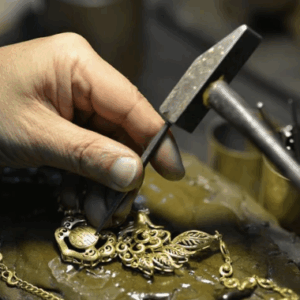
The disciplines of Art, Metalworking, and Goldsmithing represent the convergence of geology, chemistry, engineering, and aesthetics. While often used interchangeably, they represent distinct hierarchies of scale and material specialization.
Below is a detailed breakdown of these fields, from the atomic behavior of the materials to the specific movements that defined their history.
1. Definitions and Distinctions
Metalworking: The broad “parent” category covering all manipulation of metals. It spans from heavy industrial blacksmithing (iron/steel) to fine precision machining. In an art context, it usually refers to non-ferrous metals (copper, brass, bronze) used for sculpture, vessels, and architectural details.
Goldsmithing: A highly specialized subset focused on precious metals (gold, silver, platinum, palladium). Despite the name, a goldsmith works with all precious metals. The distinction is one of scale and precision; goldsmithing operates with microscopic tolerances, often involving mechanisms (hinges, clasps) and stone setting.
Silversmithing: Specifically refers to the creating of vessels (holloware) and utensils (flatware) from silver. Unlike goldsmiths who build “additive” structures (soldering parts together), silversmiths are “formers,” stretching sheet metal with hammers to create volume (bowls, teapots).
2. The Materials: Physics & Chemistry
The artistic possibilities of metal are dictated by its atomic lattice structure. Artists exploit these properties through metallurgy.
The “Noble” Metals
Gold (Au): The most malleable metal. It does not oxidize (tarnish).
Alloys: Pure 24k gold is too soft for mechanical parts. It is alloyed with copper (Rose Gold), Silver (Green Gold | Electrum), or Palladium | Nickel (White Gold) to increase hardness.
Silver (Ag): The most reflective element on earth and the highest thermal conductor.
Sterling: 92.5% Silver, 7.5% Copper. The copper adds tensile strength but causes firestain—a deep purple copper oxide shadow that appears when the metal is heated.
Platinum (Pt): Dense, “dead” (doesn’t spring back), and requires extremely high heat ($3,215^{circ} | text{F}$) to work. It does not wear away like gold; it merely displaces.
The Base Metals
Copper (Cu): The primary alloy metal. It works similarly to silver but oxidizes rapidly.
Shakudo: A Japanese alloy of Copper (96%) and Gold (4%) that can be patinated to a deep, rich purple-black using a chemical bath (rokusho).
Bronze: An alloy of Copper and Tin (typically 90/10). It is the standard for casting sculpture because it expands slightly just before solidifying, forcing the metal into the tiniest details of the mold.
Metallurgical Phenomena
Work Hardening: As metal is hammered or bent, its crystal lattice becomes distorted and “tangled.” The metal becomes hard and springy. If hammered further, it will crack.
Annealing: The process of resetting the crystal lattice. The metal is heated to a specific temperature (e.g., dull red for silver), allowing the atoms to migrate into a relaxed, stress-free alignment. This returns the metal to a malleable state.
3. The Tools of the Trade
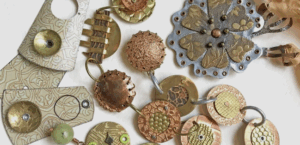
Tools in metal arts are specialized to move mass in specific directions.
Hammers:
Raising Hammer: A cross-peen hammer used to compress metal sheet against a stake to force it upright into a bowl shape.
Planishing Hammer: Has a mirror-polished, slightly convex face. Used to smooth out the lumps left by raising, leaving a signature faceted texture.
Chasing Hammer: A distinct hammer with a broad, flat face and a bulbous, springy pistol-grip handle. It is designed to strike steel punches rapidly without vibrating the artist’s arm.
Stakes and Anvils:
T-Stake: A long T-shaped arm used to reach deep inside vessels.
Mushroom Stake: A domed head used for smoothing rounded forms.
Sinusoidal Stake: A snake-like wave form used to forge complex “anticlastic” (saddle-shaped) curves.
Cutting Tools:
The Burin (Graver): A hardened steel cutter pushed by hand to gouge lines out of metal. The Onglette is a specific boat-shaped graver used for cutting sharp curves and stone setting.
4. Core Techniques
Forming (Moving Metal)
Raising: The act of hammering a flat sheet of metal over a stake to raise the sides into a hollow vessel. It creates compression, thickening the rim.
Forging: Using a hammer to change the cross-section of a metal bar (e.g., tapering a square rod into a needle point).
Surface Decoration
Repoussé: Working from the back of the metal sheet to push relief designs outward. The metal is usually mounted in a bowl of Pitch (a tar-like substance made of pine rosin, tallow, and brick dust) which supports the metal so it doesn’t collapse while stretching.
Chasing: Working on the front of the metal with small steel punches to refine the details and outline the forms created by repoussé.
Mokume Gane: A Japanese laminate technique. Sheets of alternating metals (gold, silver, copper) are fused into a solid block (billet), then carved and forged flat to reveal wood-grain patterns.
Goldsmithing Specialties
Granulation: An ancient Etruscan technique of fusing microscopic gold spheres ($0.1| text{–}1.0 | text{ mm}$) onto a surface without solder. It uses Colloidal Soldering (a mix of hide glue and copper salt) which lowers the melting point of the gold just at the contact point.
Filigree: Twisted wires of gold or silver soldered into intricate lace-like openwork frames.
Enameling (Fusing Glass to Metal)
Cloisonné: “Cells” are built on the metal surface using thin flat wires. Wet enamel powder is packed into these cells and fired.
Champlevé: “Raised field.” The metal surface itself is carved or etched away to create pits, which are then filled with enamel.
Plique-à-jour: “Glimpse of day.” Enamel is fired into cells with no backing, creating a miniature stained-glass effect. This is notoriously difficult as the glass has no structural support.
5. Historical Movements & Style
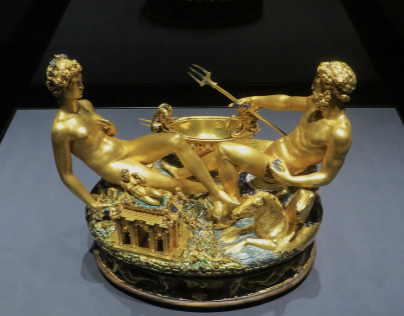
Renaissance (14th–17th C): Defined by Benvenuto Cellini. Metalwork was intellectual sculpture. Tableware (like the Saliera) featured complex mythological figures cast in gold.
Arts and Crafts (1880–1920): Led by C.R. Ashbee. A rebellion against the perfection of the machine. Artists left hammer marks visible on silver to prove it was handmade. Preferred “humble” stones like moonstone and cabochons over faceted diamonds.
Art Nouveau (1890–1910): Defined by René Lalique. Used Plique-à-jour enamel to create translucent dragonfly wings and organic, sinuous plant forms. Value came from the artistic design, not the carat weight of the materials.
Bauhaus (1919–1933): Led by Marianne Brandt. “Form follows function.” Metalwork became geometric (spheres, cylinders). The focus was on prototypes for industrial mass production, eliminating all ornament.
Art Deco (1920–1939): Defined by Edgar Brandt (ironwork). Aggressive geometry, sunbursts, and speed lines. Combined ancient materials (lacquer) with industrial machine aesthetics (chrome).
Route
Art Galerie Marketplace
Avenida Raja Gabaglia, 2000 - Sala 930 - Torre 01 - Estoril
Belo Horizonte, Minas Gerais 30.494-170 Brazil
Secondary phone: +55 31 99506-1099
Email: service@artgalerie.com.br
URL: https://artgalerie.com.br/
| Monday | Open 24 hours |
| Tuesday | Open 24 hours |
| Wednesday | Open 24 hours Open now |
| Thursday | Open 24 hours |
| Friday | Open 24 hours |
| Saturday | Open 24 hours |
| Sunday | Open 24 hours |