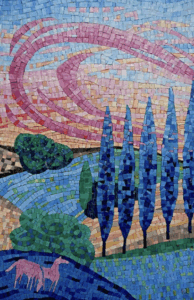
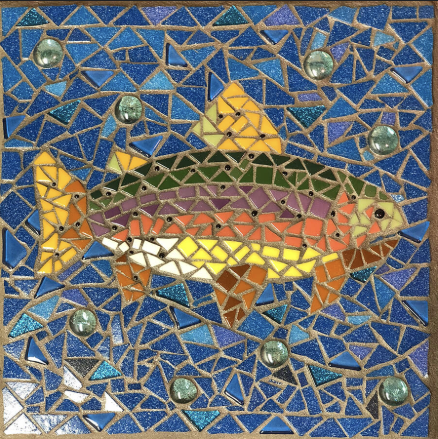
Art Mosaic is the art of creating images or patterns by assembling small pieces of colored glass, stone, or other materials. These small pieces are known as tesserae (singular: tessera).
It is an art form defined by durability and fragmentation. Unlike painting, where colors blend chemically on a canvas, mosaic relies on optical mixing—the eye blends the distinct colors of the individual stones to create the image.
Here is a minute, detailed breakdown of the world of Art Mosaic.
1. The Building Block: The Tessera
To understand mosaic, you must understand the unit of construction.
Stone & Marble: The standard for Roman floors. They offer natural, earthy tones (ochre, red, white, black). They are matte and incredibly durable underfoot.
Smalti (Byzantine Glass): The gold standard for wall mosaics.
Composition: Molten glass colored with metal oxides is poured into slabs (pizzas) and cooled. It is then chopped with a hammer.
Texture: The fractured surface is rough and uneven. This scatters light, making the mosaic sparkle.
Gold Leaf Tesserae: A “sandwich” of glass. A thin layer of 24k gold leaf is placed between a thick glass base and a thin, protective glass top layer (cartellina). Used for the shimmering backgrounds of religious icons.
Pebbles: The most primitive form. Uncut natural river stones arranged by size and color.
Ceramic: Used in modern mosaics (e.g., Gaudí’s Trencadís). Often made from broken tiles or plates.
2. The Visual Grammar: “Andamento”
In painting, you have brushstrokes. In mosaic, you have Andamento.
This refers to the flow and direction of the tesserae lines. It creates the rhythm of the artwork.
The “Opus” Styles (Latin for Work)
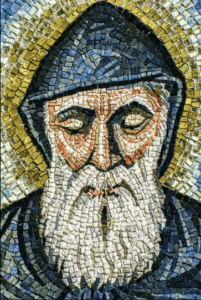
Opus Vermiculatum (“Worm-like work”): Thin, winding lines of tiny tesserae that hug the contours of a figure (e.g., outlining an eye or a muscle). This is the highest detail technique.
Opus Tessellatum: The standard background style. Uniform square pieces laid in regular horizontal or vertical rows (like a brick wall).
Opus Palladianum: “Crazy Paving.” Irregular, broken shapes fitted together like a jigsaw puzzle with no distinct rows.
Opus Sectile: This is technically not mosaic, but inlay. Large, custom-shaped slabs of stone are cut to fit a design (e.g., a single piece of marble shaped like a leaf), rather than using hundreds of tiny squares.
3. Fabrication Methods
How is a mosaic actually constructed?
A. The Direct Method
The artist applies mortar/cement to the wall or floor and presses the tesserae directly into it.
Pros: Spontaneous. The artist can tilt the glass pieces to catch the light (angling).
Cons: Very tiring. Once the cement dries, mistakes are hard to fix.
B. The Indirect Method (Reverse)
The artist pastes the tesserae face-down onto a sheet of paper using water-soluble glue.
Installation: The entire paper sheet is pressed into the wet cement on the wall. Once the cement cures, the paper is soaked with water and peeled off to reveal the mosaic.
Pros: Allows for a perfectly flat surface (ideal for floors). The artist can work comfortably in a studio.
C. The Double Direct Method
The artist places the tesserae face-up on a sticky fiberglass mesh. The mesh is then embedded into the mortar. This is the standard for modern commercial mosaics.
4. Tools of the Trade
Mosaic tools are ancient and brutal.
The Hammer and Hardie: The classic tools used since Roman times.
The Hardie: A chisel-like blade set upright in a log.
The Hammer: A heavy steel hammer with a sharp carbide edge.
The Action: The artist places the glass/stone on the Hardie and strikes it with the Hammer. This fractures the material cleanly.
Wheeled Nippers: A plier-like tool with two sharp carbide wheels. Used to “bite” glass into specific shapes.
5. Historical Evolution
A. Ancient Greek (Pebble Mosaics)
Use of natural uncut pebbles. Limited color palette (Black and White).
B. Roman (The Floor)
The Romans industrialized mosaic. They used it for durability in villas and baths.
Style: Realistic vignettes (pictures) surrounded by geometric borders. They often depicted food scraps (The Unswept Floor), guard dogs (Cave Canem), or marine life.
C. Byzantine (The Wall)
The “Golden Age” of mosaic (5th–15th Century). Centered in Ravenna and Constantinople.
Shift: Mosaic moved from the floor to the walls and ceilings.
Style: Spiritual, anti-realistic. Figures float in a golden void. The use of Smalti and angled glass created a mystical, shimmering light meant to look like heaven.
D. Islamic (Zellij)
Because Islam generally forbids the depiction of living figures, they mastered Geometric Abstraction.
Zellij: The Moroccan art of chiseling enamel tiles into impossibly complex mathematical stars and polygons.
E. Art Nouveau (Trencadís)
Antoni Gaudí in Barcelona invented Trencadís (Pique Assiette). He covered the curves of his architecture (Park Güell) with broken ceramic plates, cups, and tiles, recycling waste into art.
6. Micro-Mosaics (Jewelry)
In the 18th and 19th centuries, Italian artisans created mosaics so small they look like paintings.
Filati: They spun glass into thread-like rods, cut them into tiny dots (thousands per square inch), and set them into jewelry or snuff boxes. This is a high-value category for collectors.
Interstices: The spaces between the tiles (the grout lines).
Grout: The paste used to fill the interstices. In Roman times, they barely used grout (tight fit). In modern mosaic, grout color can change the look of the art.
Substrate: The base surface (wood, concrete, mesh) the mosaic is glued to.
1. Marquetry (Wood Mosaic).
2. Stained Glass (Light Mosaic).
3. Mosaic (Stone | Glass Mosaic).
Route
Art Galerie Marketplace
Avenida Raja Gabaglia, 2000 - Sala 930 - Torre 01 - Estoril
Belo Horizonte, Minas Gerais 30.494-170 Brazil
Secondary phone: +55 31 99506-1099
Email: service@artgalerie.com.br
URL: https://artgalerie.com.br/
| Monday | Open 24 hours Open now |
| Tuesday | Open 24 hours |
| Wednesday | Open 24 hours |
| Thursday | Open 24 hours |
| Friday | Open 24 hours |
| Saturday | Open 24 hours |
| Sunday | Open 24 hours |