Art Neoclassicism (meaning “New Classicism”) was the dominant artistic movement in Europe from the mid-18th century until the early 19th century (roughly 1760–1840).
It was a movement of order, reason, and morality. While the previous styles (Baroque and Rococo) were emotional, dramatic, and decorative, Neoclassicism was cold, logical, and serious. It sought to revive the “pure” artistic ideals of Ancient Greece and Rome.
It is intimately tied to the Age of Enlightenment and the French Revolution.
Here is a detailed breakdown of the movement.
1. The Origins: Why did it start?
Neoclassicism was born from three major events:
1. The Excavation of Pompeii (1748): When archaeologists dug up the ancient Roman cities of Pompeii and Herculaneum, which had been buried by ash, the world went crazy for antiquity. Artists finally had real examples of Roman frescoes and domestic life to study.
2. The Enlightenment: Philosophers like Voltaire and Rousseau argued that society should be ruled by Reason, not by the whims of Kings or the Church. They wanted art to be intellectual, not just pretty.
3. Hatred of Rococo: The intellectuals despised the Rococo style (associated with Marie Antoinette), viewing it as frivolous, immoral, and erotic. They wanted art that taught “virtue” and “patriotism.”
2. Key Characteristics
Neoclassicism is famously described by the German art historian Johann Joachim Winckelmann as having “Noble Simplicity and Quiet Grandeur.”
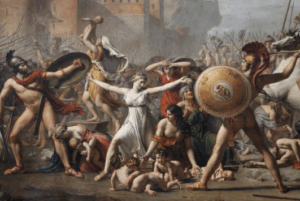
Line over Color: Neoclassicists believed that drawing (the intellect) was superior to color (emotion). Their paintings have razor-sharp outlines and invisible brushstrokes.
Frozen Action: The figures often look like statues. Even in scenes of violence, the characters remain stoic and controlled.
Stage-like Setting: The background is usually shallow, like a theater stage, forcing the viewer to focus on the human figures in the front.
Subject Matter: History, mythology, and tales of self-sacrifice. The goal was didactic—to teach the viewer how to be a good citizen.
3. The Master: Jacques-Louis David
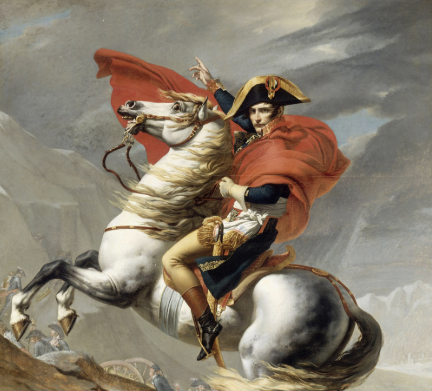
One man defined this movement: Jacques-Louis David. He was not just a painter; he was the visual dictator of the French Revolution.
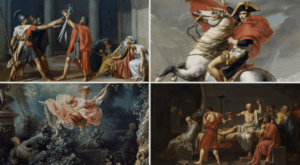
The Manifesto: His painting The Oath of the Horatii (1784) is the perfect example of Neoclassicism. It shows three brothers swearing to die for Rome. It is a call to duty, patriotism, and self-sacrifice. The men are rigid and geometric (strong); the women are curved and weeping (weak).
Political Propaganda: During the Revolution, David painted The Death of Marat. He turned a radical journalist (Marat) who was stabbed in his bathtub into a tragic, Christ-like martyr of the Revolution.
4. Neoclassical Sculpture
Sculptors tried to emulate the perfect white marble of ancient Greek statues (not knowing that Greek statues were originally painted bright colors!).
Antonio Canova: The most famous sculptor of the era. He smoothed the marble until it looked like soft skin.
Famous Work: Psyche Revived by Cupid’s Kiss. A complex composition of flying wings and embracing limbs, widely considered one of the most romantic sculptures ever made.
Bertel Thorvaldsen: A Danish sculptor who was even more strict and austere than Canova, often accused of being “cold.”
5. Neoclassical Architecture
You see this style every day, especially in government buildings.
The Look: Massive columns, triangular pediments, and domes. It screams “authority” and “democracy.”
Examples:
The Pantheon (Paris): Originally a church, now a mausoleum for French heroes.
The White House & U.S. Capitol: The founding fathers of the USA loved Neoclassicism because it linked their new republic to the democracy of Ancient Greece and the republic of Rome.
The Brandenburg Gate (Berlin).
6. The Student: Jean-Auguste-Dominique Ingres
David’s most famous student was Ingres (pronounced Ang-ruh). He was obsessed with the “perfect line.”
The Distortion: Ingres loved line so much that he would anatomically distort bodies to make the curve more elegant.
Famous Work: The Grand Odalisque. If you look closely at this painting of a nude woman, her back is too long—she has about three extra vertebrae. Ingres didn’t care about anatomy; he cared about the beauty of the curve.
7. The End: The Romantic Backlash
Neoclassicism eventually felt too restrictive. A new generation of artists wanted emotion, chaos, and color again.
The Rivalry: The art world split into two camps: the Neoclassicists (led by Ingres, defending “Line”) and the Romantics (led by Delacroix, defending “Color”).
8. Why does it matter?
Neoclassicism established the “Academic” standard of art. For the next 100 years, art schools taught students that drawing was more important than color and that the only “worthy” subjects were history and mythology. This is exactly the “system” that the Impressionists eventually rebelled against.
Route
Art Galerie Marketplace
Avenida Raja Gabaglia, 2000 - Sala 930 - Torre 01 - Estoril
Belo Horizonte, Minas Gerais 30.494-170 Brazil
Secondary phone: +55 31 99506-1099
Email: service@artgalerie.com.br
URL: https://artgalerie.com.br/
| Monday | Open 24 hours Open now |
| Tuesday | Open 24 hours |
| Wednesday | Open 24 hours |
| Thursday | Open 24 hours |
| Friday | Open 24 hours |
| Saturday | Open 24 hours |
| Sunday | Open 24 hours |