Art Nouveau (French for “New Art”) was a short-lived but explosive international art movement that flourished between roughly 1890 and 1910. It was a deliberate attempt to abandon the “historical revivals” (like Neoclassicism or Gothic Revival) of the 19th century and create a truly modern style based on nature.
The movement was driven by the philosophy of Gesamtkunstwerk (“total work of art”)—the idea that architects and designers should control every detail of a human environment, from the structure of the building down to the doorknobs, silverware, and wallpaper.
Here is a detailed breakdown of the movement, its characteristics, and its regional variations.
1. Key Characteristics
Art Nouveau is instantly recognizable by its rejection of straight lines and right angles.
The Whiplash Line: This is the signature motif of the movement. It is a sudden, violent, asymmetrical curve that snaps back on itself, mimicking the movement of a whip or a growing vine.
Organic Inspiration: Artists looked to nature, but not the “pretty” nature of the Renaissance. They focused on “humbler” or stranger life forms:
Flora: Stems, roots, lilies, vines, thistles, and seaweed.
Fauna: Dragonflies, peacocks, swans, and beetles.
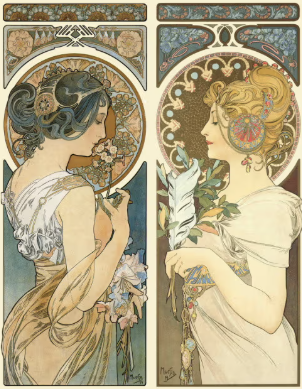
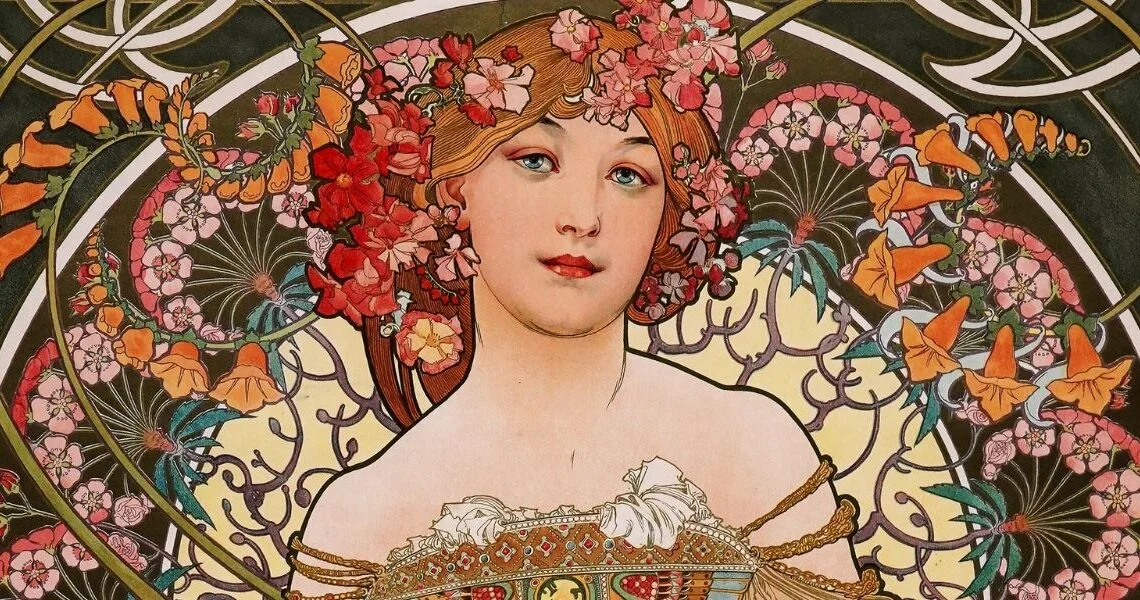
The “Femme Nouvelle”: Women were a central theme, often depicted as mysterious, sensual figures with incredibly long, flowing hair that blended into the decorative borders of the artwork (most famous in the posters of Alphonse Mucha).
Modern Materials: While they valued craftsmanship, they embraced industrial materials like iron and glass, twisting them into organic shapes previously thought impossible for metal.
2. Regional Variations
Art Nouveau was a global phenomenon, but it looked different depending on where you were. It had different names in different countries:
A. France & Belgium (Art Nouveau)
The birthplace of the movement. The style here was curvy, floral, and highly decorative.
Hector Guimard: Famous for designing the Paris Métro entrances. He used cast iron to create structures that looked like alien flower stalks rising from the pavement.
Victor Horta (Belgium): Considered the “father” of Art Nouveau architecture. His Hôtel Tassel in Brussels is the first true Art Nouveau building, featuring an open floor plan where iron columns curve seamlessly into the ceiling like trees.
René Lalique: Revolutionized jewelry by using glass, enamel, and horn rather than just diamonds and gold, valuing artistic design over material cost.
B. Spain (Modernisme)
Centered in Barcelona, this was the most eccentric and distinct variation.
Antoni Gaudí: The genius of the movement. His buildings, like Casa Batlló and the Sagrada Família, appear to be living organisms. He famously hated straight lines, stating, “The straight line belongs to men, the curved one to God.” His work featured skeletal arches and colorful mosaic tiles (trencadís).
C. Austria (Vienna Secession)
A more geometric, linear, and abstract version of the style.
Gustav Klimt: The movement’s most famous painter. His “Golden Phase” (e.g., The Kiss) combined realistic human faces with flat, abstract, gold-leaf patterns.
Otto Wagner: An architect who bridged the gap to modernism, using cleaner lines and bolts as decorative elements.
D. United States (Tiffany Style)
While Europe focused on architecture, the U.S. excelled in glass and lighting.
Louis Comfort Tiffany: He invented Favrile glass, a type of iridescent glass where the color is ingrained in the material rather than painted on. His stained-glass lamps are the definitive American contribution to the style.
E. Scotland (Glasgow Style)
Charles Rennie Mackintosh: Led the “Glasgow Four.” His style was much lighter, more vertical, and restrained than the French version, often incorporating elongated lines and subtle rose motifs.
3. Why did it end?
Art Nouveau burned out quickly around 1910 for two main reasons:
1. Cost: It was incredibly expensive. The “total work of art” philosophy meant furniture and decor had to be custom-made for specific rooms. It could not be easily mass-produced for the growing middle class.
2. Shift in Taste: As World War I approached, the flowery, decadent style began to feel excessive. It was replaced by Art Deco, which was streamlined, geometric, and celebrated the machine age rather than nature.
4. Summary Table: Art Nouveau vs. Art Deco
People often confuse these two. Here is the difference:
Feature Art Nouveau (1890–1910) Art Deco (1920–1940)
Primary Shapes Curves, loops, asymmetrical lines Triangles, zig-zags, geometric shapes
Inspiration Nature (flowers, insects, vines) Machines (cars, airplanes, skyscrapers)
Mood Romantic, flowing, mystical Sleek, fast, powerful, luxurious
Example The Paris Metro entrances The Chrysler Building (NYC)
Fun Fact: Art Nouveau had a massive revival in the 1960s. The psychedelic rock posters for bands like Pink Floyd and The Grateful Dead were direct visual copies of Art Nouveau graphic design, borrowing the swirling hair and vibrating colors.
Route
Art Galerie Marketplace
Avenida Raja Gabaglia, 2000 - Sala 930 - Torre 01 - Estoril
Belo Horizonte, Minas Gerais 30.494-170 Brazil
Secondary phone: +55 31 99506-1099
Email: service@artgalerie.com.br
URL: https://artgalerie.com.br/
| Monday | Open 24 hours Open now |
| Tuesday | Open 24 hours |
| Wednesday | Open 24 hours |
| Thursday | Open 24 hours |
| Friday | Open 24 hours |
| Saturday | Open 24 hours |
| Sunday | Open 24 hours |