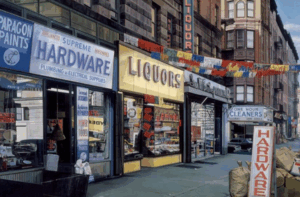
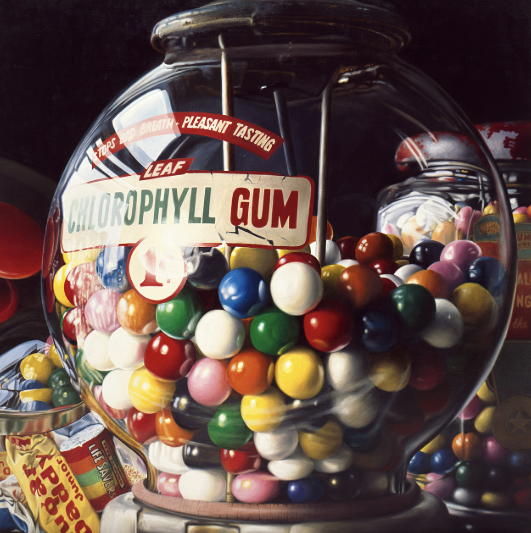
Art Photorealism is a genre of art that encompasses painting, drawing, and other graphic media, in which an artist studies a photograph and then attempts to reproduce the image as realistically as possible in another medium.
Emerging in the late 1960s and early 1970s in the United States, it was a counter-movement to Abstract Expressionism and Minimalism. While Abstract Expressionism was about spontaneous emotion, Photorealism was about calculated, mechanical precision.
Here is a minute, detailed breakdown of the movement.
1. The Core Philosophy: “The Camera is the Subject”
The most important thing to understand about Photorealism is that the artist is not painting reality; they are painting a photograph of reality.
The Intermediary: In traditional realism (like the Renaissance), the artist looks at a tree and paints a tree. In Photorealism, the artist takes a photo of a tree, develops the photo, and then paints the photo.
Camera Artifacts: Photorealists intentionally replicate the flaws of the camera, such as:
Depth of Field: If the background of the photo is blurry (out of focus), the artist paints it blurry.
Halation: The way light spreads around bright objects on film.
Lens Flare: The reflection of light within the camera lens.
Objectivity: The goal is usually to be emotionally neutral. The artist acts as a human camera, transcribing visual data without “interpreting” it or adding emotional brushstrokes.
2. The “Meisel Rules”
In 1969, art dealer Louis K. Meisel coined the term “Photorealism” and established a five-point definition to distinguish true Photorealists from regular realistic painters:
1. The Photo-Realist uses the camera and photograph to gather information.
2. The Photo-Realist uses a mechanical or semi-mechanical means to transfer the information to the canvas (e.g., a grid or projector).
3. The Photo-Realist must have the technical ability to make the finished work look photographic.
4. The artist must have exhibited work as a Photo-Realist by 1972 to be considered a founder.
5. The artist must have devoted at least five years to the development and performance of these techniques.
3. The Technical Process
Photorealism requires immense patience and technical skill. The process is often more important than the subject.
A. The Source Material
The artist acts as a photographer first. They take hundreds of slides (transparencies) to find the perfect composition. They look for high-contrast lighting and complex surfaces (glass, chrome, metal) that show off technical skill.
B. The Transfer Method
To ensure perfect proportions, the artist transfers the image to the canvas using one of two methods:
The Grid System: A grid is drawn on the photo and a corresponding grid on the canvas. The artist paints one tiny square at a time. This breaks the image down into abstract shapes of color, preventing the brain from “guessing” what the object looks like.
Slide Projection: The artist projects the photographic slide directly onto the canvas in a dark room and traces the details.
C. The Painting Technique
The Airbrush: Many Photorealists (like Paul Sarkisian and Chuck Close) used an airbrush. This sprays a fine mist of paint, eliminating brushstrokes. This mimics the smooth, grain-less look of a glossy photograph.
Layers: They work in thin, transparent glazes of oil or acrylic. They do not use “impasto” (thick texture). The surface of a Photorealist painting is usually dead flat.
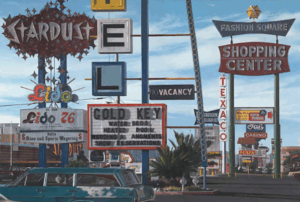
4. Typical Subject Matter
The movement is heavily associated with Americana and the post-war consumer landscape.
Reflective Surfaces: Storefront windows, diners with neon signs, glass bottles, and silverware. The complexity of painting a reflection within a reflection was a favorite challenge (e.g., Richard Estes).
Vehicles: Motorcycles, pickup trucks, and cars with shiny chrome bumpers (e.g., Ralph Goings, Tom Blackwell).
The Banal: Ketchup bottles, salt shakers, gumball machines, and toys.
Portraits: Extreme close-ups of faces, showing every pore, wrinkle, and stray hair (e.g., Chuck Close).
5. The Key Artists (The Big Four)
A. Richard Estes (The Master of Reflections)
He is famous for painting New York City street scenes.
Style: He focuses on glass storefronts and the reflections of the street in them. His paintings are often sharper than a photograph because he would combine multiple photos to ensure everything from the foreground to the background was in perfect focus.
Key Work: Telephone Booths (1967).
B. Chuck Close (The Portraitist)
He painted massive (9-foot tall) portraits of his friends and family (and himself).
Motivation: Close suffered from prosopagnosia (face blindness). He painted faces to force himself to commit them to memory.
Technique: He used a strict grid. In his later career (after being paralyzed), he filled the grid squares with abstract blobs of color that form a realistic face only when viewed from a distance.
Key Work: Big Self-Portrait (1967-1968).
C. Audrey Flack (The Emotional Realist)
One of the few women in the movement. She broke the “cool, detached” rule.
Style: She painted “Vanitas” still lifes—collections of jewelry, makeup, hourglasses, and skulls.
Technique: She was the first Photorealist to use the airbrush extensively. She projected slides directly onto the canvas.
Key Work: Marilyn (Vanitas).
D. Ralph Goings (The Chronicler of California)
He painted the quiet, sun-drenched culture of California.
Subjects: Pickup trucks, diner counters with ketchup and mustard bottles, and Airstream trailers.
Style: His work is exceptionally smooth and luminous, capturing the specific quality of California morning light.
6. Photorealism vs. Hyperrealism
These terms are often used interchangeably, but there is a distinction.
Feature Photorealism (1960s/70s) Hyperrealism (2000s–Present)
Tool Analog Camera | Film Digital Camera | High-Res Sensors
Look mimics a photo (grain, blur) Sharper than the human eye (HD)
Emotion Detached, neutral, objective Narrative, emotional, social commentary
Medium Mostly Paint Paint + Silicone Sculpture (Ron Mueck)
7. Legacy and Criticism
Photorealism was initially hated by critics. They called it “mindless copying” and argued that if you wanted a photo, you should just take a photo.
The Defense: Photorealists argued that their art was about perception. By forcing the viewer to look at a mundane object (like a ketchup bottle) for a long time, the object becomes monumental and abstract.
Today: It remains popular with the public because of the sheer “wow factor” of the technical skill involved. It paved the way for modern digital art and high-definition aesthetics.
Route
Art Galerie Marketplace
Avenida Raja Gabaglia, 2000 - Sala 930 - Torre 01 - Estoril
Belo Horizonte, Minas Gerais 30.494-170 Brazil
Secondary phone: +55 31 99506-1099
Email: service@artgalerie.com.br
URL: https://artgalerie.com.br/
| Monday | Open 24 hours Open now |
| Tuesday | Open 24 hours |
| Wednesday | Open 24 hours |
| Thursday | Open 24 hours |
| Friday | Open 24 hours |
| Saturday | Open 24 hours |
| Sunday | Open 24 hours |