
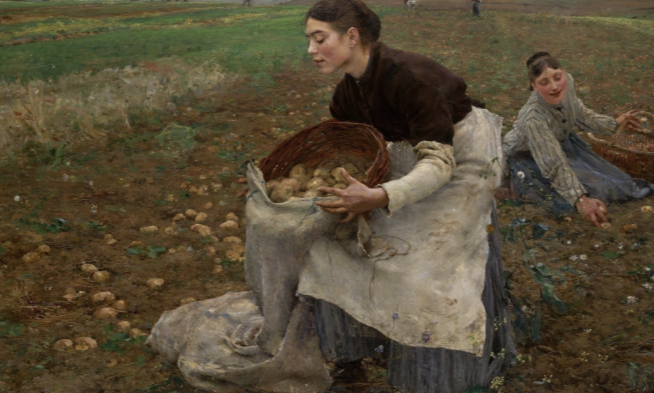
Art Realism is an artistic movement that emerged in France in the 1840s, shortly after the 1848 Revolution. It is often called the beginning of modern art.
Its philosophy can be summed up by the famous quote from its leader, Gustave Courbet: “Show me an angel, and I will paint one.”
Until this point, art was expected to idealize reality—to paint gods, heroes, angels, and dramatic historical battles. Realists rejected all of that. They believed art should depict the ugly, boring, and gritty truth of everyday life without filtering it.
Here is a detailed breakdown of the movement.
1. The Historical Context: Why did it happen?
Realism was a direct rebellion against Romanticism (the dominant style of the early 1800s, which focused on intense emotion and exotic beauty) and Neoclassicism (which focused on perfection).
The 1848 Revolution: Europe was swept by a wave of democratic revolutions. There was a new focus on the “Common Man,” the worker, and the poor.
The Industrial Revolution: Society was changing. People were moving to cities, factories were rising, and there was a new class struggle between the bourgeoisie (middle class) and the proletariat (workers). Realists wanted to paint this struggle.
The Invention of Photography (1839): The camera proved that reality could be captured instantly. Realist painters didn’t want to mimic photos; they wanted to capture the social reality that cameras of the time couldn’t yet interpret.
2. Key Characteristics
Realism is defined by its subject matter more than a specific painting technique.
Subject Matter: Peasants, stone breakers, prostitutes, beggars, and the working class.
No Idealization: If a peasant had dirty feet and missing teeth, the artist painted dirty feet and missing teeth. They refused to “clean up” the scene for the enjoyment of rich patrons.
Large Scale: Traditionally, massive canvases were reserved for “History Paintings” (Kings and Generals). Realists famously painted poor peasants on massive canvases, implying that a worker was just as important as a King.
Earthy Palette: They used browns, ochres, grays, and blacks—the colors of the earth and the city—rejecting the bright, artificial colors of Romanticism.
3. The Leader: Gustave Courbet
Courbet was the loud, arrogant, and brilliant face of the movement. He was a provocateur who deliberately tried to offend the art establishment.
The Scandal: In 1855, his work was rejected by the Universal Exhibition in Paris. In response, he built his own tent right next to the official exhibition and called it “The Pavilion of Realism.” This was the first act of an artist going “independent.”
Key Work: A Burial at Ornans (1849).
The Image: A massive (22 feet long) painting of a funeral in a muddy country village.
The Shock: There is no drama. No angels in the sky. The mourners look bored or distracted. A dog is wandering around. Critics called it “a glorification of ugliness,” but Courbet argued it was the absolute truth of death.
Key Work: The Stone Breakers. Two men breaking rocks on the side of the road. One is too old for the work, the other too young. It was a critique of poverty.
4. The Peasant Painter: Jean-François Millet
While Courbet was urban and aggressive, Millet focused on the quiet dignity of the rural poor. He was part of the Barbizon School (painters who worked in the forest of Fontainebleau).
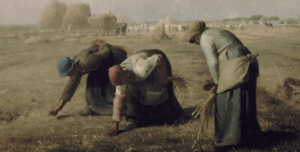
Key Work: The Gleaners (1857).
The Image: Three women bending over to pick up the tiny scraps of wheat left behind after the harvest.
The Meaning: It highlighted the contrast between the rich harvest in the distance and the extreme poverty of the women in the foreground. The upper class hated this painting; they feared it would incite a socialist revolution.
5. The Satirist: Honoré Daumier
Daumier was primarily a printmaker and caricaturist for newspapers. He used Realism as a political weapon.
The Third-Class Carriage: A painting showing the cramped, dark interior of a train car filled with the working poor. It captures the weariness and claustrophobia of modern urban life.
6. The American Connection
Realism traveled to the United States later in the 19th century, where it became known for a slightly more scientific approach.
Thomas Eakins: Obsessed with anatomy and accuracy. His painting The Gross Clinic (showing a bloody surgery in progress) was considered too graphic for mixed audiences.
Winslow Homer: Painted the raw power of the ocean and the struggles of fishermen and sailors without romanticizing the danger.
7. Summary Comparison: Romanticism vs. Realism
Feature Romanticism (c. 1800–1850) Realism (c. 1840–1880)
Goal Escape reality Confront reality
Emotion Intense, dramatic, fearful Detached, observational
Subjects Heroes, exotic lands, legends Workers, peasants, funerals
Idealization High (Make it beautiful) None (Make it true)
Palette Vibrant, dramatic lighting Earthy, muddy, natural light
Example Liberty Leading the People The Stone Breakers
8. Why does it matter?
Realism broke the biggest rule of art: that art exists to make the world look better than it is.
Democratization: It proved that the life of a common person was worthy of high art.
The Path to Impressionism: By focusing on “what is actually there,” Realism paved the way for Manet and the Impressionists, who took that idea and applied it to light and color.
Next Step:
Since you have asked about almost every major modern art movement, there is one distinct “dream-like” gap in our timeline that connects Van Gogh’s psychology to the modern era.
Would you like me to cover Surrealism (Salvador Dalí, René Magritte)? This movement took the “Realist” painting technique but applied it to dreams and nightmares rather than the real world.
Route
Art Galerie Marketplace
Avenida Raja Gabaglia, 2000 - Sala 930 - Torre 01 - Estoril
Belo Horizonte, Minas Gerais 30.494-170 Brazil
Secondary phone: +55 31 99506-1099
Email: service@artgalerie.com.br
URL: https://artgalerie.com.br/
| Monday | Open 24 hours Open now |
| Tuesday | Open 24 hours |
| Wednesday | Open 24 hours |
| Thursday | Open 24 hours |
| Friday | Open 24 hours |
| Saturday | Open 24 hours |
| Sunday | Open 24 hours |
