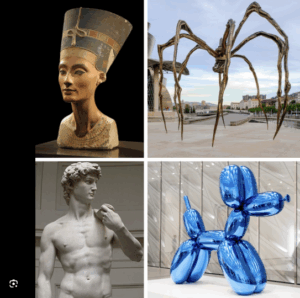
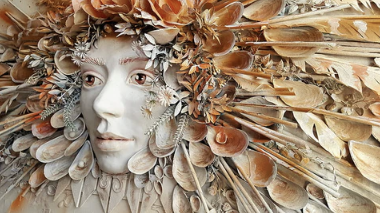
Art Sculpture is the branch of the visual arts that operates in three dimensions. It is one of the “Plastic Arts,” meaning it involves the shaping or modeling of material.
Unlike painting, which creates the illusion of space on a flat surface, sculpture inhabits the same physical space as the viewer. It has height, width, and depth. It interacts with light, casts real shadows, and demands to be viewed from multiple angles.
Here is a minute, detailed breakdown of the world of Sculpture.
1. The Four Basic Methods
Every sculpture in history was created using one (or a combination) of these four processes.
A. Carving (Subtractive Process)
This is the most unforgiving method. The artist starts with a block of material (stone, wood) and removes what they do not want.
The Risk: Once material is removed, it cannot be put back. There is no “undo” button.
The Concept: Michelangelo famously described this as “liberating the figure from the marble.” He believed the statue was already inside, waiting to be revealed.
B. Modeling (Additive Process)
The artist builds up the form using a soft, malleable material (clay, wax, plaster).
Armature: Large sculptures require an internal skeleton made of wire or wood to support the weight of the wet clay so it doesn’t collapse.
Flexibility: This is the most spontaneous method. Material can be added, removed, and reshaped endlessly until it is fired or cast.
C. Casting (Substitution Process)
This involves making a mold of an original model (usually clay or wax) and pouring a liquid material (bronze, resin, plaster) into it to harden.
The Lost Wax Process (Cire Perdue): The ancient, complex method for casting bronze.
1. Make a clay model.
2. Cover it in wax.
3. Cover the wax in a heat-resistant mold (investment).
4. Heat it so the wax melts and drains away (“lost”), leaving a hollow cavity.
5. Pour molten bronze into the cavity.
D. Assembly (Construction Process)
A modern technique where the artist joins pre-existing materials together.
Welding: Fusing metal plates and rods (pioneered by Picasso and Julio González).
Assemblage: Gluiing, bolting, or tying found objects (trash, wood, plastic) together to create a new form.
2. The Materials
The material dictates the look, the durability, and the cost of the sculpture.
A. Stone
Marble: The gold standard of the Renaissance. It is metamorphic rock. It has a slight translucency (subsurface scattering) that mimics human flesh. It is soft enough to carve but hard enough to hold detail.
Granite: Igneous rock. Extremely hard and difficult to carve. Used for monumental outdoor statues (e.g., Ancient Egyptian obelisks).
Limestone/Sandstone: Softer, sedimentary rocks. Easier to carve but they erode quickly in the weather.
B. Metal
Bronze: An alloy of Copper and Tin. It is the most popular metal because it expands slightly as it cools, forcing it into the tiniest details of the mold. It is incredibly durable.
Steel/Iron: Used in modern industrial sculpture (e.g., Richard Serra). It rusts (oxidizes) unless treated or made of Cor-ten steel.
C. Wood
Grain: The sculptor must carve with the grain. Carving against it causes splitting.
Checking: As wood dries, it shrinks and cracks (checks). Artists must account for this, or hollow out the log to relieve tension.
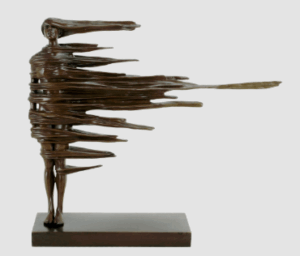
D. Clay | Terracotta
Terracotta: “Baked Earth.” Clay that has been fired in a kiln. It is usually reddish-brown and unglazed. It is fragile but can last thousands of years if buried (e.g., The Terracotta Army).
3. Types of Sculpture (Spatial Relationship)
How does the sculpture exist in space?
A. Sculpture in the Round (Free-Standing)
The sculpture is finished on all sides. The viewer is expected to walk around it. The experience changes as you move (e.g., Michelangelo’s David).
B. Relief Sculpture
The figures project from a supporting background (usually a wall).
Bas-Relief (Low Relief): The projection is slight, like the face on a coin.
Haut-Relief (High Relief): The figures project more than 50% from the background. Sometimes heads or limbs are completely detached (undercut).
Sunken Relief (Intaglio): The image is carved into the surface, rather than popping out (common in Ancient Egypt to preserve the silhouette in harsh sunlight).
C. Kinetic Sculpture
Sculpture that moves.
Mobiles: Balanced structures moved by air currents (Alexander Calder).
Machinery: Motorized sculptures (Jean Tinguely).
D. Installation | Site-Specific
The art is not just the object, but the environment.
Land Art: Sculpting the earth itself (Robert Smithson’s Spiral Jetty).
Installation: Filling a room with objects to create an immersive experience.
4. Key Terminology for your Marketplace
Patina: The surface color of a bronze sculpture. It is achieved by applying chemicals (acids) and heat. It can be green (verdigris), brown, black, or gold. Crucial for valuation.
Maquette: A small, preliminary model (sketch) made of wax or clay before the artist commits to the full-size stone or bronze work.
Edition: Bronze sculptures are cast in editions (e.g., 1 of 12). The mold is destroyed after the edition is full.
Contrapposto: A pose where the figure’s weight rests on one leg, causing the hips and shoulders to tilt in opposite directions. It creates a natural, relaxed “S-curve” (introduced by the Greeks).
Negative Space: The holes or voids within a sculpture. Henry Moore is famous for treating the “hole” as an object in itself.
5. Historical Evolution (The “Vibe”)
Ancient Egypt: Block-like, rigid, static. Designed to last for eternity.
Ancient Greece: Idealized beauty, athleticism, and the invention of natural movement (Contrapposto).
Renaissance (1400-1600): Hyper-realistic anatomy and emotion (Michelangelo, Donatello).
Baroque (1600-1750): Extreme drama, wind, movement, and twisting spirals (Bernini).
Modern (1880-Present):
Rodin: Left surfaces rough and unfinished to catch the light.
Brancusi: Simplified forms to their “essence” (e.g., Bird in Space).
Minimalism: Industrial materials, geometric shapes, no emotion (Donald Judd).
Summary Comparison: Additive vs. Subtractive
Feature Subtractive (Carving) Additive (Modeling)
Material Stone, Wood Clay, Wax, Plaster
Process Removing material Adding | Building material
Correction Impossible (High Risk) Easy (Low Risk)
Structure Must be self-supporting Needs an internal armature
Texture Defined by tools (chisels) Defined by fingers/spatulas
Strategic Conclusion:
This completes the deep dive into Sculpture. You now have a complete glossary for your marketplace categories:
Painting (Oil, Acrylic)
Graphic Art (Prints, Drawings)
Sculpture (Bronze, Stone, Wood)
Decorative Art (Ceramics, Furniture)
Route
Art Galerie Marketplace
Avenida Raja Gabaglia, 2000 - Sala 930 - Torre 01 - Estoril
Belo Horizonte, Minas Gerais 30.494-170 Brazil
Secondary phone: +55 31 99506-1099
Email: service@artgalerie.com.br
URL: https://artgalerie.com.br/
| Monday | Open 24 hours Open now |
| Tuesday | Open 24 hours |
| Wednesday | Open 24 hours |
| Thursday | Open 24 hours |
| Friday | Open 24 hours |
| Saturday | Open 24 hours |
| Sunday | Open 24 hours |