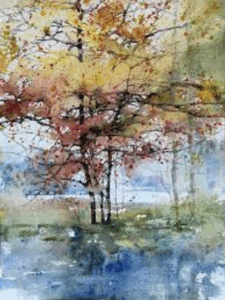
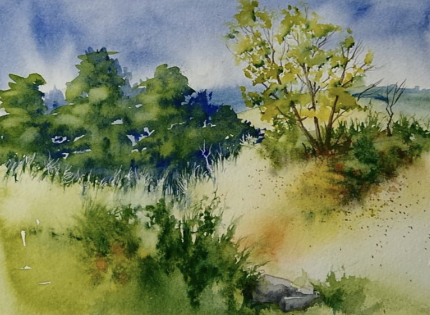
Art Watercolor painting (also known as aquarelle in French) is a painting method in which the paints are made of pigments suspended in a water-based solution.
It is arguably the most unforgiving and yet the most luminous of all art mediums. Unlike oil or acrylic, where you can paint over mistakes, watercolor is transparent. Once a mark is made, it is difficult to hide. The white of the paper serves as the light source, shining through the thin layers of pigment to create a glow that no other medium can replicate.
Here is a minute, detailed breakdown of the world of watercolor.
1. The Chemistry of the Paint
To understand watercolor, you must understand what it is made of. It is deceptively simple, consisting of two main ingredients:
Pigment: The dry powder that provides color.
Organic Pigments: Derived from carbon-based life (plants, animals, or modern synthetic chemistry). They tend to be transparent and staining (e.g., Phthalo Blue, Quinacridone Rose).
Inorganic Pigments: Derived from minerals and metals (earths). They tend to be opaque, sedimentary, and granulating (e.g., Burnt Sienna, Ultramarine Blue, Cadmiums).
Binder (Gum Arabic): Sap from the acacia tree. It holds the pigment in suspension and glues it to the paper fibers once the water evaporates.
Additives:
Glycerin/Honey: Plasticizers that keep the paint moist and re-wettable.
Ox Gall: A wetting agent (surfactant) that helps the paint flow over the paper rather than beading up.
2. The Surface: Why Paper Matters
In watercolor, the paper is not just a surface; it is an active participant. You are essentially dyeing the paper fibers.
A. Composition
Cotton (Rag): The gold standard. 100% cotton paper is durable, absorbs water evenly, and can handle scrubbing without pilling.
Wood Pulp (Cellulose): Cheaper. The paint sits on top rather than sinking in. It often creates hard edges and cannot handle heavy washes.
B. Texture (The “Tooth”)
1. Hot Press (HP): The paper is ironed hot between cylinders. The surface is extremely smooth. Good for fine detail and illustration, but difficult for large, smooth washes.
2. Cold Press (CP) / Not: The paper is pressed through cold felt rollers. It has a slight texture (bumpiness). This is the most popular surface because the texture traps pigment, creating “sparkle.”
3. Rough: The paper is dried without pressing or between rough felts. It has deep pits. Paint settles into the hollows (granulation), creating immense texture.
C. Weight
Paper is measured by weight (per ream).
90 lb (190 gsm): Thin, buckles easily when wet. Needs stretching.
140 lb (300 gsm): The standard. Handles wash well but may buckle slightly.
300 lb (640 gsm): Thick like cardboard. Absorbs massive amounts of water and stays flat.
3. Fundamental Techniques
Watercolor relies on the manipulation of the “water cycle”—how wet the paper is versus how wet the brush is.
A. Washes
Flat Wash: A single, even layer of color without streaks.
Graded Wash (Ombré): Fading a color from dark to light by gradually adding more water to the brush as you move down the page.
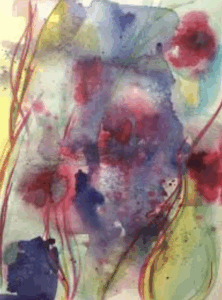
Variegated Wash: Dropping different colors into a wet surface and letting them mix naturally.
B. Wet-on-Wet vs. Wet-on-Dry
Wet-on-Wet: Painting onto wet paper. The edges of the stroke explode and fuzz out (blooming). Used for soft skies, backgrounds, and shadows.
Wet-on-Dry: Painting onto dry paper. The stroke retains a razor-sharp edge. Used for details, architecture, and defining forms.
C. Glazing (Layering)
Because watercolor is transparent, you mix colors by layering them. Painting a transparent yellow over a dry blue creates green. This is called “optical mixing.”
D. Negative Painting
In oils, you paint the object. In watercolor, you often paint the space around the object to define it. To show a white fence, you paint the dark green bushes behind it, leaving the white paper untouched.
4. Special Effects (The “Tricks”)
Watercolorists use physics to create texture.
Granulation: Heavy pigments (like Ultramarine Blue) separate from the water and settle into the paper’s valleys, creating a speckled texture.
Salt: Sprinkling salt into a wet wash absorbs the water and pushes the pigment away, creating star-like crystals or snowflakes.
Lifting: Using a damp brush or sponge to remove paint from the paper to create highlights (clouds, sunbeams).
Masking Fluid: Liquid latex applied to the paper to waterproof it. It preserves the white of the paper while you paint over it. It is peeled off later.
5. Historical Evolution
Albrecht Dürer (Renaissance): Used watercolor for botanical and nature studies (e.g., The Great Piece of Turf).
The English School (18th/19th Century): The Golden Age of watercolor.
J.M.W. Turner: He revolutionized the medium, using it expressively to capture light and atmosphere rather than just topography.
John Constable: Used it for landscape sketches.
Winslow Homer & John Singer Sargent (American): Sargent is considered the greatest watercolorist of all time. He treated watercolor with the same boldness as oil, using confident, singular brushstrokes to capture light on architecture and figures.
6. Transparency vs. Opacity (Gouache)
It is important to distinguish Watercolor from Gouache (Body Color).
Watercolor: Transparent. The light comes from the paper.
Gouache: Opaque watercolor. Chalk is added to the pigment. The light reflects off the surface of the paint. You can paint light gouache over dark gouache (impossible in true watercolor).
7. Why is it considered the “Master’s Medium”?
There is a saying: “Oil painting is like driving a car; watercolor is like riding a wild horse.”
The Timing: You have to know exactly when the paper is “shiny wet,” “satin wet,” or “damp.” Painting at the wrong second causes “back-runs” (cauliflowers)—ugly watermarks that ruin the image.
The Shift: Watercolor dries lighter and duller than it looks when wet (the “drying shift”). The artist must calculate this shift in their head while painting.
No “Undo”: You cannot paint white over a mistake. You have to plan the white areas before you put the brush down.
Route
Art Galerie Marketplace
Avenida Raja Gabaglia, 2000 - Sala 930 - Torre 01 - Estoril
Belo Horizonte, Minas Gerais 30.494-170 Brazil
Secondary phone: +55 31 99506-1099
Email: service@artgalerie.com.br
URL: https://artgalerie.com.br/
| Monday | Open 24 hours Open now |
| Tuesday | Open 24 hours |
| Wednesday | Open 24 hours |
| Thursday | Open 24 hours |
| Friday | Open 24 hours |
| Saturday | Open 24 hours |
| Sunday | Open 24 hours |