Graphic Arts is a broad category of visual arts based on the use of lines and tones on a two-dimensional surface, rather than color and three-dimensional modeling (which are associated with painting and sculpture).
Historically, the term referred strictly to printmaking and drawing. In the modern era, it has expanded to encompass Graphic Design, digital illustration, typography, and web design. It is the intersection of art, communication, and technology.
Here is a minute, detailed breakdown of the Graphic Arts ecosystem.
1. The Core Definition
The term comes from the Greek word graphikos, meaning “belonging to writing” or “to draw.”
Primary Focus: Line, shape, contrast, and tone.
Secondary Focus: Color (often used flatly or decoratively, rather than atmospherically).
Key Characteristic: Reproducibility. Unlike a singular oil painting, graphic arts are often created to be printed, reproduced, and distributed (e.g., posters, books, engravings, digital files).
2. The Traditional Mediums (Fine Graphic Arts)
Before computers, graphic arts were physical, manual processes. These techniques are still practiced today as “Fine Art Printmaking.”
A. Drawing & Illustration
The foundation of all graphic arts.
Media: Graphite, charcoal, pastel, conté crayon, silverpoint.
Ink: Pen and ink, brush and ink (Sumi-e). This relies on hatching and cross-hatching to create depth and shadow using only black lines.
B. Printmaking (The “Big Four” Techniques)
This is the mechanical heart of graphic arts.
1. Relief Printing: The image is printed from the raised surface of a block. You cut away the white parts; the remaining raised parts take the ink.
Woodcut: The oldest technique. Harsh, bold lines.
Linocut: Uses linoleum. Softer, fluid lines.
2. Intaglio (Engraving): The opposite of relief. The image is incised into a plate (copper or zinc). Ink is forced into the grooves, the surface is wiped clean, and damp paper pulls the ink out of the grooves under high pressure.
Etching: Acid is used to bite lines into the metal.
Drypoint: A needle scratches the metal directly, creating a fuzzy “burr.”
Aquatint: Uses powdered rosin to create tonal areas (shading) rather than lines.
3. Planographic (Lithography): Printing from a flat surface based on the principle that oil and water do not mix.
The artist draws with a greasy crayon on a limestone slab. The stone is wet with water (which repels the grease) and rolled with oil-based ink (which sticks to the grease).
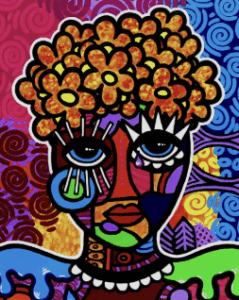
4. Stencil (Serigraphy/Screen Printing): Ink is forced through a fine mesh screen onto paper or fabric. A stencil blocks the ink from passing through non-image areas. Famous for the Pop Art movement (Andy Warhol).
3. The Modern Mediums (Commercial Graphic Arts)
This is what most people today refer to as “Graphic Design.” It serves a commercial purpose: to communicate a specific message to a specific audience.
A. Typography
The art and technique of arranging type to make written language legible, readable, and appealing.
Typeface: The design of the letters (e.g., Helvetica, Garamond).
Font: The specific file or mechanism (e.g., Helvetica Bold 12pt).
Kerning: Adjusting the space between individual characters.
Leading: The vertical space between lines of text.
Hierarchy: Using size and weight to tell the reader what to read first.
B. Branding and Identity
Creating visual systems for companies.
Logo Design: The reduction of a complex identity into a single symbol or wordmark.
Color Theory: Using psychology to evoke emotion (e.g., Blue for trust/finance, Red for hunger/urgency).
C. Vector vs. Raster Graphics
In digital graphic arts, there are two mathematical ways to create an image:
1. Raster (Bitmap): Made of pixels (tiny colored squares). Best for photos. If you zoom in, it blurs. (File types: JPG, PNG).
2. Vector: Made of mathematical formulas (paths and anchor points). You can resize it to the size of the moon and it will remain crisp. Best for logos and illustrations. (File types: SVG, AI, EPS).
4. Historical Evolution
Antiquity: Egyptian hieroglyphs and illuminated manuscripts (calligraphy).
1440 (The Gutenberg Press): Johannes Gutenberg invented movable type. This democratized knowledge and birthed the publishing industry.
1890s (Art Nouveau): The first major “Graphic Style” applied to posters. Curvilinear lines, organic shapes (Alphonse Mucha, Toulouse-Lautrec).
1919 (The Bauhaus): A German school that merged art with industry. They established the principles of modern design: “Form Follows Function.” They stripped away decoration in favor of geometry and grids.
1950s (The Swiss Style): The International Typographic Style. Clean, asymmetric layouts, sans-serif typefaces, and white space.
1984 (The Digital Revolution): The launch of the Apple Macintosh and PostScript. This allowed designers to control type and image on a screen, killing the traditional typesetting industry.
5. Key Principles of Graphic Art
To create a successful composition, graphic artists use these mathematical and aesthetic rules:
The Golden Ratio ($\phi$): Approximately $1.618$. It is used to determine pleasing proportions in page layouts and logo designs.
The Grid System: An invisible structure of columns and rows used to align elements and create order.
Negative Space (White Space): The area around the subject. In graphic arts, the empty space is just as important as the filled space (e.g., the hidden arrow in the FedEx logo).
Balance:
Symmetrical: Mirror image (formal, static).
Asymmetrical: Different elements on each side, but with equal visual weight (dynamic, modern).
6. Tools of the Trade
Category Tools
Analog Pencils (H/B scale), T-Square, X-Acto Knife, French Curves, Brayer (roller), Burin (gouging tool).
Digital Software Adobe Photoshop (Raster/Photo manipulation), Adobe Illustrator (Vector/Logo), Adobe InDesign (Page Layout/Books).
Hardware Wacom Tablets, iPad Pro (Procreate), High-resolution monitors (color calibrated).
7. Industry Applications
Where do Graphic Artists work today?
Advertising: Billboards, social media ads.
Publishing: Book covers, magazine layouts.
Packaging Design: Boxes, bottles, labels (a massive industry).
User Interface (UI) Design: The visual “skin” of apps and websites.
Motion Graphics: Animated graphic design for film titles and TV.
Route
Art Galerie Marketplace
Avenida Raja Gabaglia, 2000 - Sala 930 - Torre 01 - Estoril
Belo Horizonte, Minas Gerais 30.494-170 Brazil
Secondary phone: +55 31 99506-1099
Email: service@artgalerie.com.br
URL: https://artgalerie.com.br/
| Monday | Open 24 hours Open now |
| Tuesday | Open 24 hours |
| Wednesday | Open 24 hours |
| Thursday | Open 24 hours |
| Friday | Open 24 hours |
| Saturday | Open 24 hours |
| Sunday | Open 24 hours |