1. The Philosophy: Humanism
To understand the art, you must understand the mindset. The Middle Ages: Focused on the afterlife. The body was seen as shameful or temporary; the soul was everything. The Renaissance: Focused on this life. Inspired by the rediscovery of Ancient Greek and Roman texts, scholars argued that "Man is the measure of all things." The Result: Art became about idealizing the human body, intellect, and emotion. Religious figures (Jesus, Mary) were painted to look like real, breathing humans with weight and feelings, rather than golden icons.2. Key Innovations (The "Tech" of Art)
Renaissance artists were often mathematicians and scientists. They invented tools to make art look like a window into reality.A. Linear Perspective
This was the game-changer. Rediscovered by the architect Filippo Brunelleschi, this mathematical system uses a "vanishing point" on the horizon line to create the illusion of 3D depth on a flat surface. Before: Figures were sized by importance (God was big; people were small). After: Figures were sized by how far away they were.B. Anatomy
Artists began illegally dissecting corpses to understand how muscles and bones worked under the skin. Michelangelo and Leonardo da Vinci were obsessed with anatomical correctness. This is why Renaissance statues look like they could step off their pedestals.C. Chiaroscuro & Sfumato
Chiaroscuro: The use of strong contrast between light and dark to give figures volume and weight. Sfumato: Invented by Da Vinci. It means "smoky." It is the technique of blurring outlines so there are no harsh edges, mimicking how the eye sees in soft light (seen in the Mona Lisa).3. The Three Phases
A. The Early Renaissance (c. 1400–1490)
Centered in Florence. This was the era of experimentation and discovery. Donatello: The sculptor who brought back the nude figure. His bronze David was the first free-standing nude statue since antiquity. Sandro Botticelli: Painted The Birth of Venus. Interestingly, he rejected deep perspective for a more decorative, flowing line, bridging the Gothic and Renaissance styles. Masaccio: The first painter to master perspective perfectly in The Holy Trinity.B. The High Renaissance (c. 1490–1527)
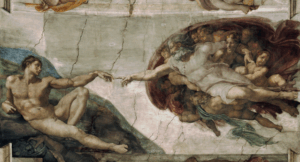
Centered in Rome. This was the peak. The techniques were mastered, and the artists became superstars ("The Geniuses"). The Big Three: Leonardo, Michelangelo, and Raphael. Characteristics: Perfect balance, triangular compositions (pyramid shape), and calm, god-like dignity.C. The Northern Renaissance
While Italians painted frescoes, artists in the Netherlands and Germany developed Oil Paint. Focus: They cared less about perspective and Greek statues, and more about insane textural detail and domestic interiors. Jan van Eyck: The master of oil paint. He could paint the reflection of a window in a bead of sweat.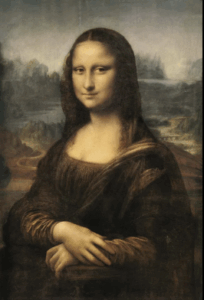
4. The Titans: "The Big Three"
Artist Role Notable Work Style
Leonardo da Vinci The Scientist Mona Lisa, The Last Supper The "Renaissance Man." He used science to inform art. Famous for psychological depth and sfumato. Michelangelo The Sculptor David, Sistine Chapel Ceiling Believed sculpture was the highest art. His figures are muscular, tense, and powerful (Terribilità). Raphael The Perfector The School of Athens Combined Leonardo's softness with Michelangelo's power. Known for grace, harmony, and beautiful Madonnas.5. Renaissance Architecture
Architects rejected the spiky, complex Gothic style. They returned to the symmetry, domes, and columns of Rome. Brunelleschi's Dome: The Duomo in Florence. He figured out how to build a massive dome without it collapsing, a feat that had been lost since the Romans built the Pantheon. St. Peter's Basilica: The ultimate expression of Renaissance grandeur in the Vatican.6. Summary Comparison: Middle Ages vs. Renaissance
Feature Middle Ages (Medieval) Renaissance Focus God & The Afterlife Human Potential & Nature Perspective Flat, hierarchical Deep, linear (3D) Bodies Covered, stiff, stylized Nude, muscular, anatomical Signature Anonymous craftsmen Famous individual artists Patron The Church The Church + Wealthy Merchants (Medici)7. The End and Legacy
The High Renaissance ended around 1527 (the Sack of Rome). Transition: Artists felt that "perfection" had been achieved and there was nowhere left to go. They started breaking the rules (making bodies too long, colors too bright), leading to a style called Mannerism. Impact: The Renaissance established the Western Canon. It created the concept of the "Artist as Genius" and laid the foundation for the scientific revolution.Next Step:
This concludes the chronological "Golden Age" of art. Renaissance: Balance and Reason. Baroque: Drama and Emotion (which we covered earlier). Neoclassicism: A return to Renaissance logic (which we covered).Route
Art Galerie Marketplace
5 Brayford Sq, Stepney Green
London E1 0SG United Kingdom (UK)
Additional phone number: +55 31 99506-1099
Email: service@artgalerie.com.br
URL: https://artgalerie.com.br/
| Monday | Open 24 hours |
| Tuesday | Open 24 hours |
| Wednesday | Open 24 hours Open now |
| Thursday | Open 24 hours |
| Friday | Open 24 hours |
| Saturday | Open 24 hours |
| Sunday | Open 24 hours |